
Bonvista Financial Services Pvt. Ltd. is an AMFI registered Mutual Fund Distributor holding ARN No.136656
Bonvista Financial Services Pvt. Ltd.
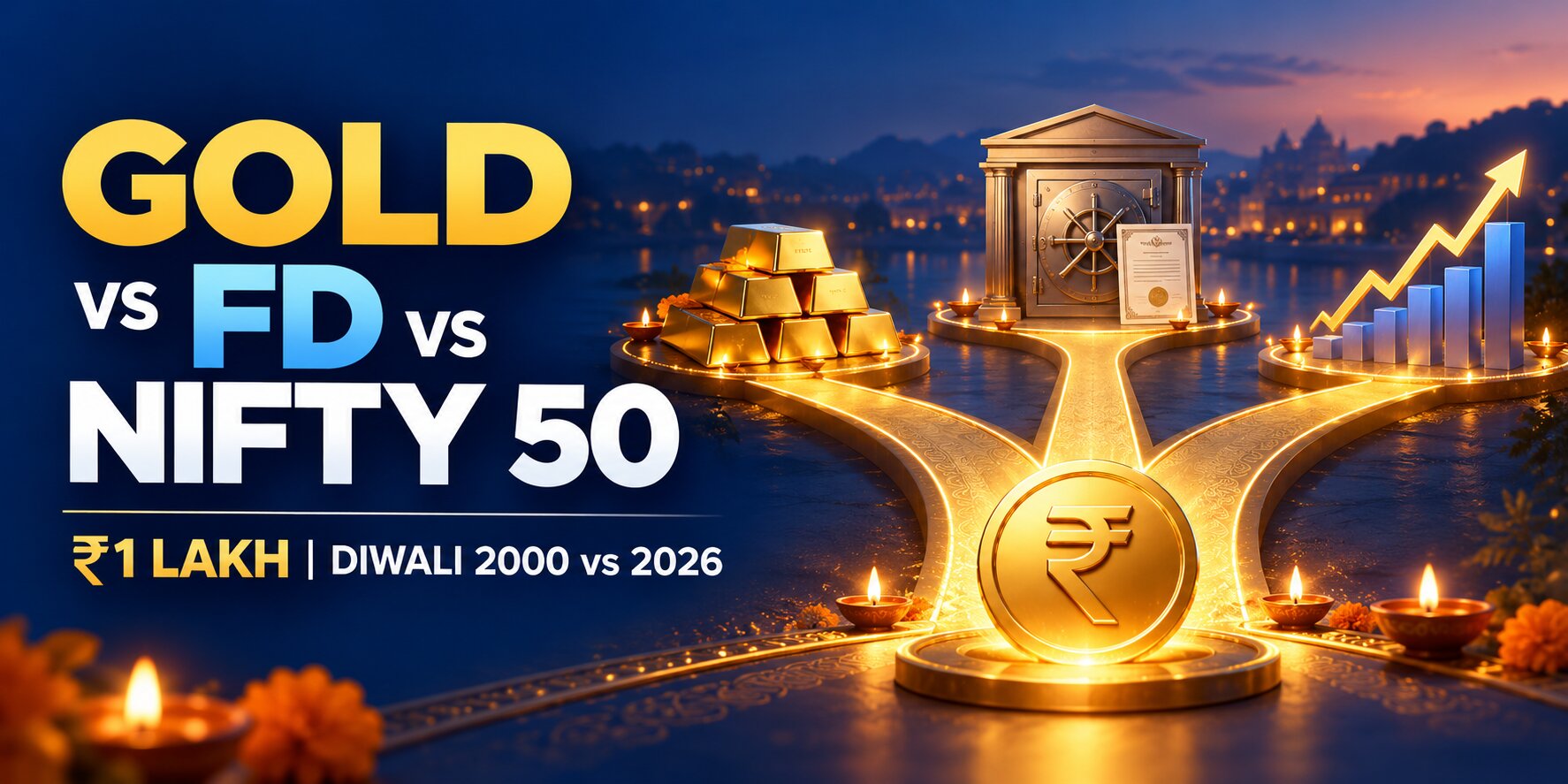
Key Takeaways: 26-Year Return Snapshot (Diwali 2000 – Diwali 2026)
Gold (~14% CAGR): Turned Rs. 1 Lakh into >Rs. 30 Lakhs (moving from ~Rs. 4,400 to ~Rs. 1.42 Lakh per 10g), driven heavily by a sharp surge between 2023 and 2026.
Nifty 50 / Equities (~12% CAGR): Turned Rs. 1 Lakh into >Rs. 18 Lakhs on a price basis, offering participation in Indian corporate growth alongside dividend income.
Bank Fixed Deposits (~7% Illustrative CAGR): Turned Rs. 1 Lakh into ~Rs. 5.80 Lakhs pre-tax, providing capital stability and predictable income for short-term goals.
Core Wealth Lesson: Historical winners rotate across cycles. Sustainable wealth creation requires strategic asset allocation aligned with your risk profile, investment horizon, and financial plan.
Diwali is a festival of prosperity, new beginnings, and financial optimism. Across India, families buy gold, renew fixed deposits, invest in shares, and make plans to build a more secure future. They worship “Goddess Lakshmi”.|
But have you ever wondered what would have happened if you had invested Rs. 1 lakh during Diwali in 2000 and held that investment until Diwali 2026?
Would gold have created the greatest wealth? Would a bank fixed deposit have quietly grown substantially through compound interest? Or would the Nifty 50 (Equity), representing some of India's largest listed companies, have delivered the highest long-term return?
The answer offers more than a comparison of investment returns. It reveals how different assets behave over time, how compounding works, and why investment decisions should consider both risk and reward.
Let's examine these three popular investment choices over about 26 years.
1. Gold: The Traditional Hedge Against Inflation and Uncertainty
For Indian households, gold is much more than just a metal. It is associated with festivals, weddings, family traditions, and financial security.
In times of inflation, financial market volatility, and economic uncertainty, gold has also drawn investors.
Historical gold-price data shows that gold was available at only a few thousand rupees per 10 grams around the beginning of the 2000s. Its price subsequently increased significantly over the following decades. By Diwali 2025, one historical series placed the international-market-based value of 24-karat gold at approximately Rs. 1.25 lakh per 10 grams. In October 2026, it is around Rs. 1.42 lakh approx.
This represents a substantial long-term increase, although the exact return depends on the price series used and whether taxes and other costs are included.
How would Rs. 1 lakh invested in gold have performed?
Suppose you purchased gold worth Rs. 1 lakh around Diwali 2000 and held it until Diwali 2026.
Your final investment value would depend on three things i.e. purchasing price, selling price and the costs associated with buying and selling the gold.
Approx. during Diwali 2000, gold price per 10 grams was around Rs. 4,400/-
For example, if the price of gold increased tenfold, an initial investment of Rs. 1 lakh would become more than Rs. 30 lakhs. The annualised return over 26 years is approximately 14% per year.
Gold does not generate interest or dividends. Its return primarily comes from an increase in its market price. However, it can serve as a portfolio diversifier and may behave differently from equities during certain market conditions.
Physical jewellery also involves making charges and other expenses. Therefore, its actual investment return may be lower than the increase in the quoted gold price.
2. Fixed Deposits: Predictable Returns and Capital Stability
Fixed deposits have long been a preferred savings option for Indian households. They offer a defined interest rate for a specified tenure and are generally easier to understand than stock-market investments.
However, FD interest rates have changed considerably over the period of 26 years. It also depends on the type of bank (Private/Nationalize/Co-operative) and tenure.
Historical data indicates that typical bank deposit rates were around 9.5% to 10% in 2000–01, while rates subsequently declined and rose through different economic cycles. At present, it is around 6.5% to 7.5%
An investor who locked money into a deposit for a particular period would earn the contracted rate for that tenure, whereas an investor repeatedly renewing deposits would receive whatever rate was available at each renewal.
How could Rs.1 lakh grow in an FD over 26 years?
The basic principle is compounding: interest earned is added to the investment, and subsequent interest is calculated on the increased balance.
For illustration, consider a hypothetical fixed deposit that earns a constant 7% annual return, compounded annually, for 26 years.
This produces a maturity value of approximately Rs. 5.80 lakh before tax (so almost 6 times).
Please be aware that this is not a reconstruction of actual past FD returns; rather, it is merely a calculation. No investor could assume that one particular rate was continuously available throughout the entire period.
To calculate the actual historical FD outcome, we would need to define a specific bank, deposit tenure, compounding convention, and renewal strategy, and then apply the historical rates available at each renewal.
3. Nifty 50: (Equity Asset Class) Participating in India's Corporate Growth
Gold represents a traditional store of value, while fixed deposits focus on predictable interest income. The Nifty 50 offers a different opportunity. It allows participation in the growth of major Indian businesses.
The Nifty 50 is a benchmark stock-market index comprising 50 companies selected according to the index's eligibility and selection methodology. It covers businesses across multiple sectors of the Indian economy.
Over the past 26 years, India has experienced significant changes in technology, banking, telecommunications, consumer spending, infrastructure and financial services. Companies operating in these areas have contributed to the changing composition and performance of the Indian stock market.
However, the market has not moved upwards in a straight line. Investors have experienced the dot-com crash, the global financial crisis of 2008, the COVID-19 market shock and several other periods of volatility.
How would Rs. 1 lakh invested in the Nifty 50 have grown?
Suppose an investor invested Rs. 1 lakh in an instrument tracking the Nifty 50 around Diwali 2000 and continued holding it until Diwali 2026.
The final value would depend on the index level at both dates, the dividends received, the reinvestment of those dividends, and the expenses and tracking difference of the investment product.
Let’s look at a simple calculation. In October 2000, NIFTY 50 was around 1200 points.
Considering the price, If the price of gold increased tenfold, an initial investment of Rs. 1 lakh would become more than Rs. 18 lakhs. The annualised return over 26 years is approximately 12% per year. Unlike a bank FD, the returns are not the same every year. Being volatile is the nature of the market.
Gold Vs Bank FD vs Nifty 50: How should we compare them?
Now, let’s look at Gold vs FD vs Nifty 50: How Should We Compare Them?
All three investments can help build wealth, but they work differently.
| Factor | Gold | Bank FD | Nifty 50 |
|---|---|---|---|
| Main source of return | Price appreciation | Interest income | Share-price gains and dividends |
| Predictability | Price fluctuates | Contracted rate during deposit tenure | Market-dependent (Volatile) |
| Capital fluctuations | Yes | Generally stable in nominal terms, subject to bank and product risks | Can be substantial |
| Regular income | No | Interest, depending on payout option | Dividends through the underlying shares |
| Inflation protection | May help over long periods | Not guaranteed after tax | Potential for long-term growth, not guaranteed |
| Liquidity | Depends on the form of gold | Depends on deposit terms and premature-withdrawal rules | Liquid |
| Important cost or risk | Taxes, premiums and making charges | Tax on interest and reinvestment risk | Volatility, expenses and tracking difference |
The table shows why there is no single measure of suitability for every investor.
Someone saving for a known expense in two years may value stability more than potential growth. Another person investing for retirement over 20 years may be more willing to accept market fluctuations.
Does the Best-Performing Asset Deserve Your Entire Investment?
With the help of historical returns, investors can understand how different assets behaved in the past. They cannot guarantee which asset will perform best in the future.
Gold prices can experience long periods of weakness followed by sharp increases. Though Gold has outperformed NIFTY 50 in the last 26 years, remember that gold has generated exponential returns in the last 3-year period. During Diwali 2023, the rate of 24K gold for 10 grams was Rs. 0lakhakhs, which has grown to Rs. 1.42 lakh approx. as of now.
Let’s look at one example. From 2012 to 2018, gold had not delivered any returns. Indian gold prices were approximately Rs. 31,050 per 10 grams in 2012 and Rs. 31,438 in 2018, i.e., an increase of only about 1.25% over six years using these annual reference prices.
So, in such a period, Bank FDs can provide you with consistent and predictable returns. However, no investor can create wealth through Bank FDs alone. For creating an emergency fund and meeting very short-term needs, FDs may be useful. However, for the long term, they can destroy your purchasing power due to inflation and taxes.
On the other hand, Equities offer participation in business growth, but they can also suffer deep market declines. The best way to create long-term wealth is to invest in the equity asset class. Further, Equity investment can generate income, unlike gold. It is going to be volatile, but a diversified portfolio can reduce dependence on any one outcome.
The appropriate allocation depends on an individual's investment horizon, emergency savings, financial obligations, risk tolerance, and objectives.
A person approaching retirement may have different requirements from a young investor saving for a goal 25 years away.
The lesson is not to select an asset merely because it delivered the highest historical return. It is to understand the risks and decide how each investment fits into an overall financial plan.
Conclusion: The Real Lesson of 26 Diwalis
Diwali reminds us of prosperity and new beginnings. Looking back from 2026 to 2000 offers an opportunity to examine how different financial choices may have shaped long-term wealth.
Gold reflects the importance of a traditional asset in Indian households. Fixed deposits demonstrate the power of compounding and the value of predictable income. The Nifty 50 illustrates how investors can participate in the growth of major Indian businesses, provided they can withstand market volatility.
Perhaps the most useful financial lesson is that wealth creation depends not only on what you invest in, but also on how early you begin, how long you remain invested, the costs you incur and the discipline with which you follow your financial plan.
This Diwali, instead of asking only what to buy, consider a more valuable question – what financial decision can help build a more secure future over the next 26 years?
Frequently Asked Questions (FAQs)
Q1: Which investment gave the highest return between Diwali 2000 and Diwali 2026: Gold, FD, or Nifty 50?
Between Diwali 2000 and Diwali 2026, Gold delivered an annualised return of approximately 14% (growing Rs. 1 lakh to over Rs. 30 lakhs), largely boosted by a sharp rally between 2023 and 2026. The Nifty 50 delivered approximately 12% annualised price returns (growing Rs. 1 lakh to over Rs. 18 lakhs), while an illustrative 7% Bank FD grew to approximately Rs. 5.80 lakhs before taxes.
Q2: Why shouldn't investors put 100% of their money into Gold despite its high 26-year return?
Gold goes through extended multi-year phases of stagnation—for example, between 2012 and 2018, Indian gold prices rose by only about 1.25% in total over six years. Furthermore, gold does not generate regular income or dividends, and physical gold carries making charges and taxes.
Q3: How should I divide my investments between Gold, Fixed Deposits, and Equity?
Ideal asset allocation depends on your financial goals, investment horizon, and risk tolerance. Fixed deposits are well-suited for emergency funds and short-term needs (1–3 years), equities help build inflation-beating long-term wealth (5–25+ years), and gold serves as a portfolio diversifier and hedge against economic uncertainty.
Ready to Build Your Next 26-Year Wealth Plan?
Chasing last year's best-performing asset is not a financial plan — strategic asset allocation is. At Bonvista Financial Services (www.bonvista.in), we help you align your investments across Equities, Debt, and Gold based on your personal risk profile, family goals, and time horizon.
Connect With Our Wealth Experts
Ready to transition from reactive saving to strategic wealth creation? Let our certified team assist you with expert Portfolio Management Services (PMS), high-alpha AIF advisory, and comprehensive retirement planning.
-
Book a Consultation: Book a meeting with us for ultimate wealth creation
-
Call Us: +91 8390040100
-
Chat With Us: +91 8390040200
-
Visit Us: 506, Business Galaxy Building, Opp. Gokul Hotel, Beside Box Cricket, Kute Marg, Tidke Colony, Nashik, Maharashtra 422002
Follow for daily updates: WhatsApp | LinkedIn | YouTube | Instagram | Facebook | X | Pinterest
Disclaimer: This article is for educational and informational purposes only and does not constitute financial or investment advice. Investors should consult with their certified financial planner or wealth manager before making any investment decisions. Mutual fund and gold investments are subject to market risks.
Disclosure: Bonvista Financial Services Pvt. Ltd. is an AMFI Registered Mutual Fund Distributor holding ARN 136656
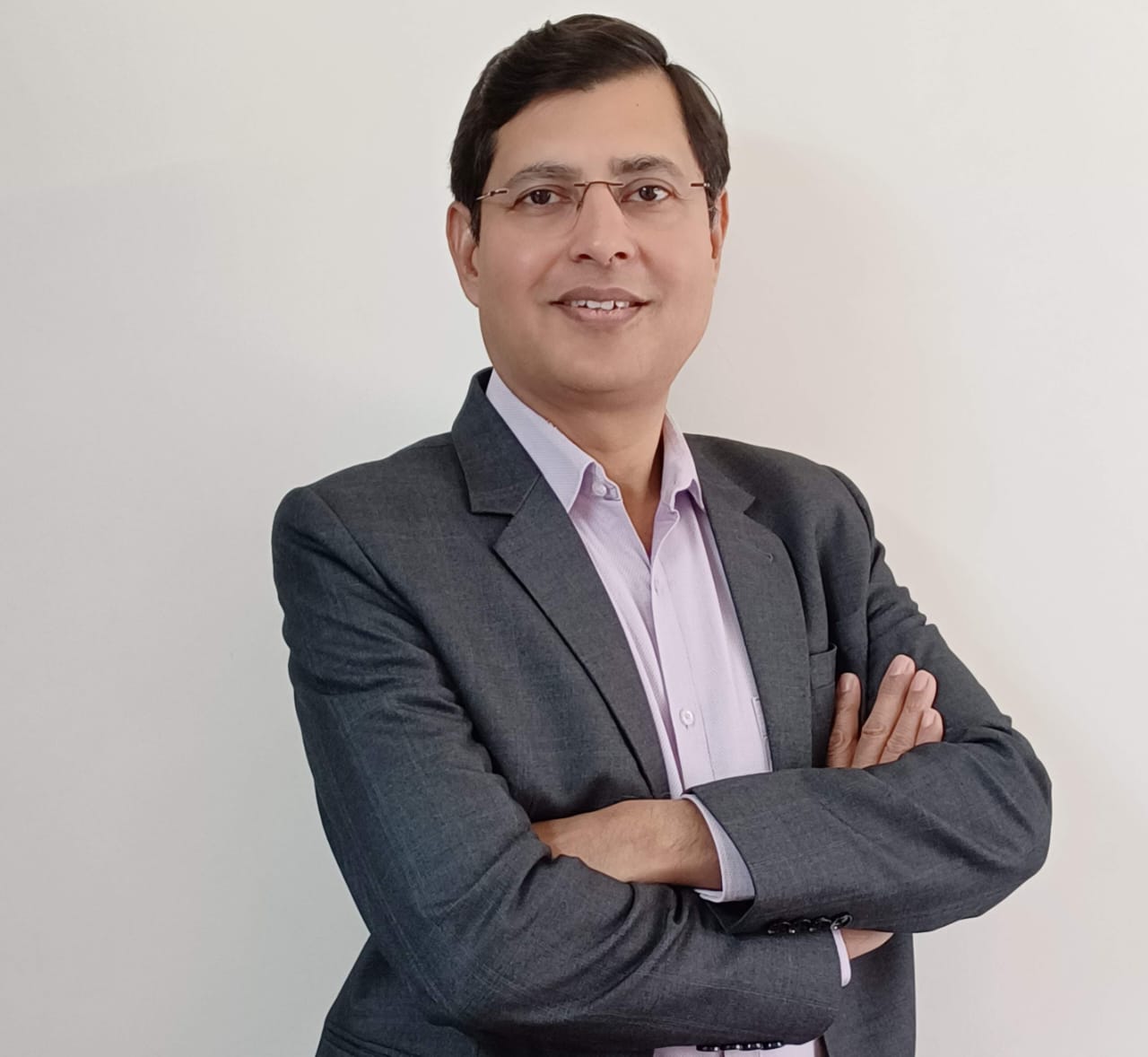
Mr. Unmesh Deshmukh
Founder & Director, Bonvista Financial Services | AMFI ARN: 136656
With over 24 years of elite experience in the financial services industry, Unmesh is a seasoned investment expert. He acts with a strict fiduciary mindset, leveraging data-backed strategies to help individuals and families create sustainable, generational wealth.
Connect on LinkedIn



Disclaimer: Mutual Fund investments are subject to market risks, read all scheme related documents carefully.
Bonvista Financial Services Pvt. Ltd. is an AMFI-Registered Mutual Fund Distributor (ARN: 136656). Any investment guidance provided is strictly incidental to our primary mutual fund distribution activity.