

Bonvista Financial Services Pvt. Ltd. is an AMFI registered Mutual Fund Distributor holding ARN No.136656
Bonvista Financial Services Pvt. Ltd.
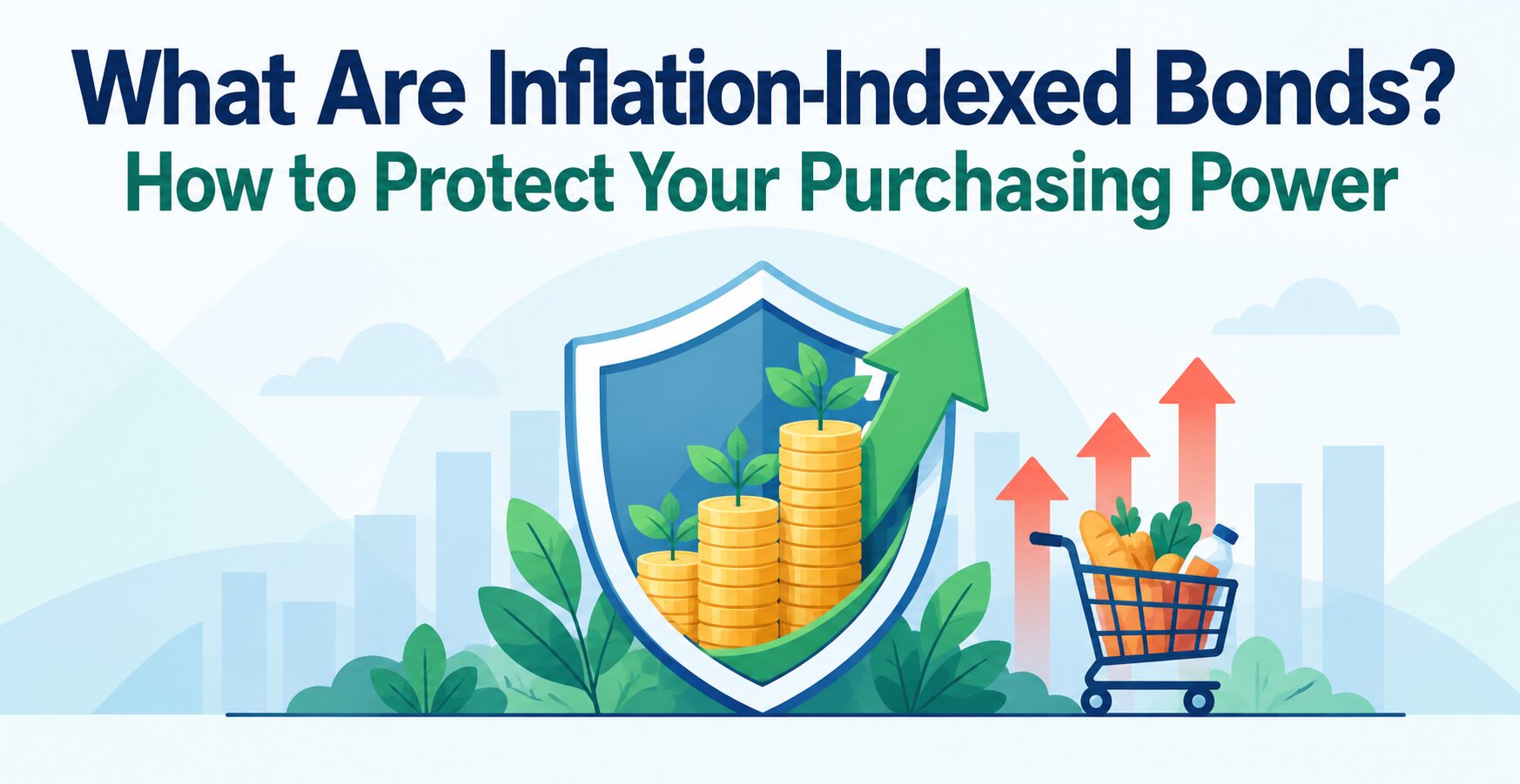
Quick Answer: What are Inflation-Indexed Bonds? An Inflation-Indexed Bond (IIB) is a secure financial instrument designed to protect your wealth from rising prices. Unlike standard fixed deposits, an IIB links your principal and interest payments directly to an official inflation index, ensuring your investment grows faster than inflation to preserve your actual purchasing power.
“Inflation” is one of the biggest financial risks while investing.
Imagine you have Rs. 10 lakhs today. You feel comfortable because Rs. 10 lakhs is a substantial amount of money. But what happens if prices keep rising over the next 10 or 15 years?
Your Rs. 10 lakhs will still be Rs. 10 lakhs in terms of the number printed on your account statement. But its purchasing power may be much lower. This is the problem created by inflation.
The price of the product will significantly increase in the future, which costs Rs. 1 lakh today. Therefore, investors should not look only at how much their money grows. They should also ask an equally important question: will my investment grow faster than inflation?
This is where Inflation-Indexed Bonds become interesting.
These bonds are designed to link the value of the investment, or the interest calculation, to an inflation measure. The objective is to reduce the impact of rising prices on the investor's purchasing power. Let's understand how they work in simple terms.
What Is an Inflation-Indexed Bond?
An Inflation-Indexed Bond, or IIB, is a bond where the investment is linked to inflation.
In a conventional bond, the investor generally receives interest based on a predetermined coupon rate on the principal. For example, suppose you invest Rs. 1 Lakh in a bond paying 7% interest. You may receive approximately Rs. 7,000 of interest per year, subject to the terms of the bond.
But there is a problem. What if inflation is 8%?
Although you earned 7% in nominal terms, your purchasing power has not necessarily increased. In real terms, inflation has been higher than your return.
An inflation-indexed structure tries to address this problem by adjusting the principal and/or interest calculation based on an inflation index. To understand how economists track these changes in the general price level, you can explore this Reserve Bank of Australia guide on inflation and measurement.
The basic idea is simple. As inflation rises, the amount used for calculating your return can rise as well. India issued Inflation-Indexed Bonds in 2013, with the objective of providing investors with protection against inflation. The original IIBs were linked to the Wholesale Price Index (WPI).
Why Does Inflation Matter to Investors?
Inflation is often described as a rise in the general price level of goods and services. But from an investor's perspective, there is an easier way to understand it: Inflation reduces the purchasing power of money.
Suppose you need Rs. 50,000 every month today to maintain your lifestyle. If inflation averages 6% for many years, the same lifestyle could require substantially more money in the future. An investment may show a positive return but still fail to protect your real wealth. You can calculate the exact impact of inflation on your long-term goals using the interactive financial tools available on the Bonvista Financial Services Calculator Hub.
For example:
|
Investment return |
Inflation |
Approx. real return |
|
8% |
5% |
3% |
|
8% |
8% |
0% |
|
8% |
10% |
-2% |
*Simplified illustration; actual real return calculation is more accurately based on (1 + return)/(1 + inflation) - 1.
The lesson is important:
A 10% return does not automatically mean you are becoming 10% richer in purchasing-power terms.
Learn Financial Concepts Without the Noise
Want to simplify complex market metrics, mutual fund concepts, and goal-based strategies?
Join our investor community on WhatsApp: Join Paise Ki Paathshaala for practical, educational insights to support your wealth journey.
How Do Inflation-Indexed Bonds Work?
Let's take a simplified example.
Suppose an inflation-indexed bond has a face value of Rs. 1,00,000.
Assume the applicable inflation adjustment for the year is 5%.
The inflation-adjusted principal becomes:
Rs. 1,00,000 × 1.05 = Rs. 1,05,000.
Now suppose the bond's fixed coupon rate is 3%.
Instead of calculating interest on the original Rs. 1,00,000, the interest may be calculated on the inflation-adjusted principal, depending on the specific structure of the bond.
At 3%:
Rs. 1,05,000 × 3% = Rs. 3,150.
Therefore, the investor benefits from two components:
“Inflation adjustment + interest on the adjusted principal”
This is the basic attraction of an inflation-linked structure. The actual calculation, however, depends on the terms of the particular issue. Investors should always check the bond's official terms rather than assuming that every inflation-linked bond works in exactly the same way.
India's 2013 IIB structure adjusted the principal for inflation, and the interest was calculated on the inflation-adjusted principal. In case of deflation, the principal at redemption was protected from falling below the original face value under that structure.
What Happens When Inflation Falls?
This is another important point. Inflation-indexed bonds are designed to work in both rising and falling inflation environments.
Suppose inflation is only 2%. The inflation adjustment will be smaller than when inflation is 7%. Therefore, the inflation-linked component of the return will also be smaller.
And what happens during deflation?
Under India's 2013 IIB structure, the inflation-adjusted principal could fall because of negative inflation, but the principal payable at redemption was protected from falling below the original face value.
This means the investor's protection mechanism is not simply:
“If Inflation goes up, return goes up.”
The actual return depends on the bond's structure and the movement of the relevant inflation index.
Inflation-Indexed Bonds vs Fixed Deposits
Consider two investors.
Investor A has invested money in Fixed Deposit:
He invests Rs. 10 lakhs in an FD earning 7%. The interest rate remains fixed according to the FD terms.
If inflation rises sharply, the purchasing power of her interest income can fall.
Investor B has invested money in Inflation-Indexed Bonds:
His investment is linked to an inflation measure according to the bond's terms.
If inflation rises, the inflation-linked adjustment can increase the principal used for calculating the return. This does not mean the inflation-indexed bond will always produce a higher nominal return than an FD.
That is an important distinction. The purpose is different.
A fixed-rate investment provides certainty about the contractual rate.
An inflation-linked investment attempts to provide protection against the loss of purchasing power caused by inflation.
Inflation-Indexed Bonds Are Not a “High Return” Product
This is perhaps the most important point for retail investors. Inflation protection should not be confused with return maximisation. Investors seeking aggressive growth should explore Specialized Investment Funds.
An investor may look at an inflation-linked bond and think inflation is 7%, so I will automatically earn 7% plus the coupon.
Not necessarily. The calculation depends on the bond's structure, reference index, coupon, and other terms.
Moreover, inflation itself is not the same for every household. A retired person may spend more on healthcare. A young family may spend more on education and housing. Another investor may spend more on travel or transportation.
Therefore, the official inflation index may not perfectly represent an individual's personal inflation rate.
The Difference Between Nominal Return and Real Return
This concept is extremely important for every investor.
- Nominal return is the return shown on your investment.
- Real return is approximately the return left after considering inflation.
For example, suppose your investment earns 9%.
If inflation is 6%, the simple way of thinking is:
9% − 6% = 3% real return
The exact calculation is slightly different:
Real return = [(1 + nominal return) / (1 + inflation)] − 1
So:
(1.09 / 1.06) − 1 ≈ 2.83%
This difference may look small over one year.
But over 10, 15 or 20 years, the impact of inflation can become significant.
Why Inflation-Indexed Bonds Can Be Useful for Long-Term Investors
Inflation becomes more important as the investment horizon increases.
Suppose someone is saving for a goal 15 years away. Instead of measuring returns, maintaining purchasing power is important.
This is particularly relevant for retirement planning.
If a person's retirement expenses rise with inflation, maintaining purchasing power becomes just as important as generating returns.
Inflation-linked investments can therefore have a role in a diversified portfolio for investors who want some protection against unexpected inflation. But they should be viewed as one component of an overall portfolio, not as a complete investment strategy.
Are Inflation-Indexed Bonds Completely Risk-Free?
Even when the issuer is the government, investors should understand the product properly.
There can be:
- Interest-rate risk
- Market-price risk if sold before maturity
- Liquidity risk
- Inflation-index mismatch
- Tax implications
- Reinvestment risk
The last point is especially important.
If an investor sells a bond before maturity, its market price may be different from the original investment value. Therefore, investors should not assume that Inflation-linked means my market value can never fall.
Inflation protection and market-price protection are two different things.
India's Experience With Inflation-Indexed Bonds
India launched Inflation-Indexed Bonds in 2013, when inflation was an important economic concern.
The first series was linked to WPI inflation and offered a fixed return over and above the inflation component. Approximately RS. 6,500 crore of such bonds were issued in 2013.
However, these bonds later became relatively illiquid as inflation moderated and WPI inflation turned negative for an extended period. The government subsequently bought back the 1.44% Inflation Government Stocks 2023 in 2016.
This history provides an important lesson:
A good investment idea still depends on product design, liquidity, market conditions and investor demand.
It is therefore important to distinguish the general concept of inflation-linked investing from the availability of a particular bond issue today.
What Should Retail Investors Check?
Before investing in any inflation-linked bond or similar product, investors should ask:
- Which inflation index is used? Is the investment linked to CPI, WPI or another index?
- What exactly gets adjusted? Is it the principal, interest, or both?
- What is the fixed coupon? Inflation protection does not mean the entire return is automatically equal to inflation.
- What happens during deflation? Check whether there is any floor or protection on the principal.
- Can I sell before maturity? If yes, understand the liquidity and market-price risks.
- What is the tax treatment? Tax can materially affect the final return. Investors should check the rules applicable at the time of investment and redemption.
- Does it match my financial goal? A product can be good but still unsuitable for a particular investor.
Inflation Is a Silent Risk
Investors usually notice market crashes. They notice when their portfolio falls 15%. But inflation works differently. It does not necessarily create a large loss on your investment statement. Instead, it gradually reduces what your money can buy.
That is why inflation can be called a silent risk to long-term wealth.
If you keep Rs. 10 lakhs in an investment that earns less than inflation for many years, the nominal amount may appear safe while its real purchasing power slowly declines.
Inflation-indexed bonds attempt to address this problem by connecting the investment to an inflation measure.
Final Takeaway
Inflation-Indexed Bonds are designed to help protect the purchasing power of money against inflation. For retail investors, the bigger lesson goes beyond one particular bond.
Whenever you evaluate an investment, don't look only at the return printed on the statement.
Instead, it's important to understand earnings, inflation, and purchasing power.
An investment that protects your purchasing power may sometimes be more valuable than an investment that shows a higher nominal return.
In the end, successful investing is not just about having more rupees. It is about having more purchasing power when you actually need the money.
Connect With Our Wealth Experts
Ready to transition from reactive saving to strategic wealth creation? Let our certified team assist you with expert Portfolio Management Services (PMS), high-alpha AIF advisory, and comprehensive retirement planning.
-
Book a Consultation: Book a meeting with us for ultimate wealth creation
-
Call Us: +91 8390040100
-
Chat With Us: +91 8390040200
-
Visit Us: 506, Business Galaxy Building, Opp. Gokul Hotel, Beside Box Cricket, Kute Marg, Tidke Colony, Nashik, Maharashtra 422002
Follow for daily updates: WhatsApp | LinkedIn | YouTube | Instagram | Facebook | X | Pinterest
Disclaimer: This article is for educational and informational purposes only and does not constitute financial or investment advice. Investors should consult with their certified financial planner or wealth manager before making any investment decisions. Mutual fund and gold investments are subject to market risks.

Mr. Unmesh Deshmukh
Founder & Director, Bonvista Financial Services | AMFI ARN: 136656
With over 24 years of elite experience in the financial services industry, Unmesh is a seasoned investment expert. He acts with a strict fiduciary mindset, leveraging data-backed strategies to help individuals and families create sustainable, generational wealth.
Connect on LinkedIn


Disclaimer: Mutual Fund investments are subject to market risks, read all scheme related documents carefully.
Bonvista Financial Services Pvt. Ltd. is an AMFI-Registered Mutual Fund Distributor (ARN: 136656).