

Bonvista Financial Services Pvt. Ltd. is an AMFI registered Mutual Fund Distributor holding ARN No.136656
Bonvista Financial Services Pvt. Ltd.
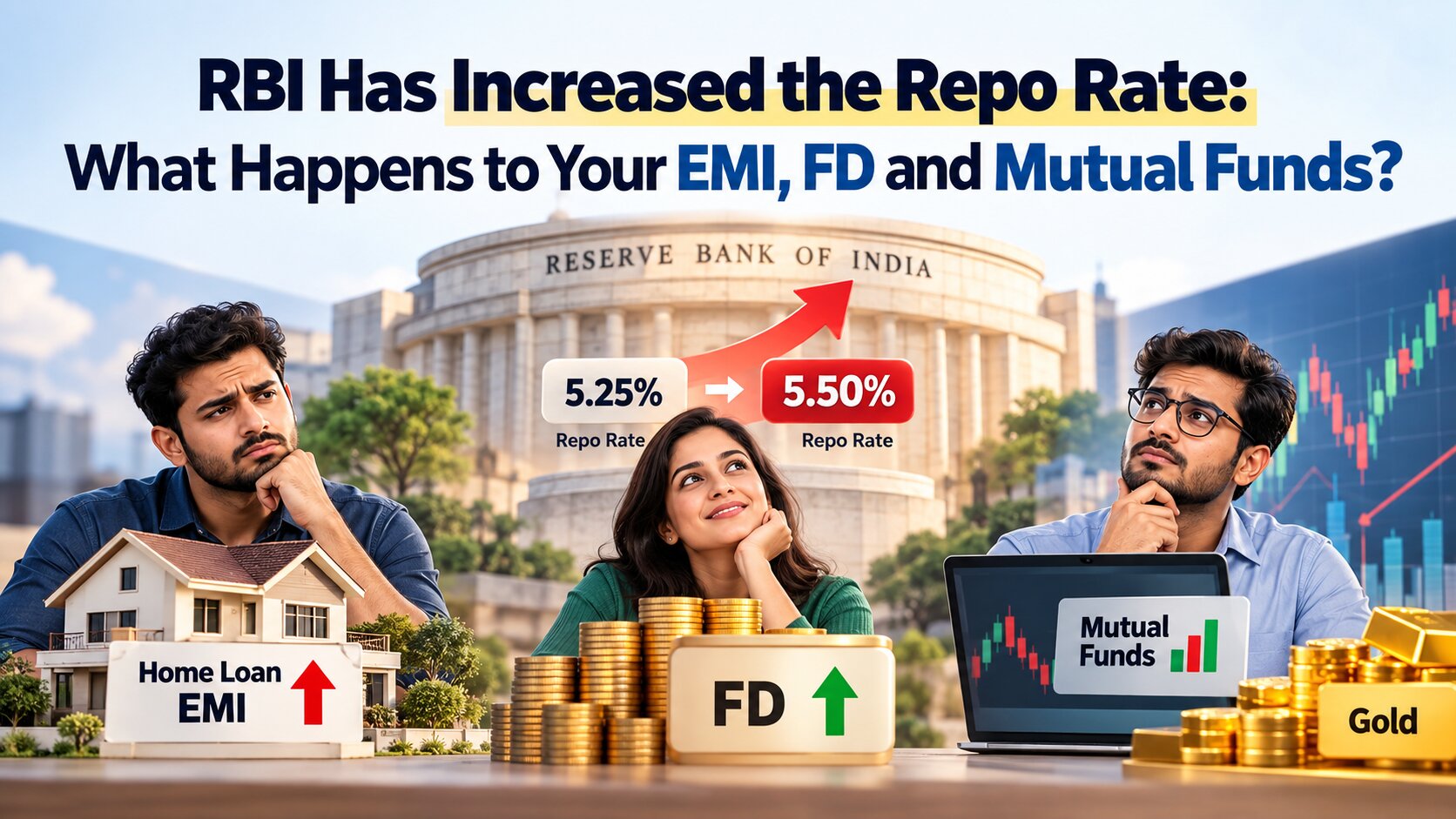
Imagine three friends sitting together after hearing the latest RBI announcement. One has a home loan. The other has invested a large amount in fixed deposits.
The borrower is worried about increasing in EMI and on the other hand the depositor is hopeful about getting a higher interest rate FDs. Meanwhile, a third person who invests through mutual funds wonders whether the stock market will fall.
All three are reacting to the same news, but its impact on each person can be different.
On 7th October 2026, the Reserve Bank of India (RBI) increased the repo rate by 25 basis points, from 5.25% to 5.50%. It was the first increase in nearly four years, and the RBI also shifted its policy stance from neutral to calibrated tightening.
But what does this decision actually mean for an ordinary Indian investor?
Let's understand it without complicated financial terminology.
Quick Summary: How the RBI Repo Rate Hike Affects You?
When the Reserve Bank of India (RBI) raises the repo rate to 5.50%, borrowing costs across the banking system increase. For retail investors, floating-rate home loan EMIs or tenures typically rise at the next reset date, new Fixed Deposit (FD) rates may gradually improve depending on bank liquidity, long-duration debt mutual funds face short-term NAV volatility, and equity mutual fund SIPs remain best aligned with long-term goal-based investing rather than short-term rate changes.
What Is the Repo Rate?
The repo rate is the interest rate at which the RBI lends short-term funds to banks against eligible securities under the repo mechanism. Think of it as an important benchmark influencing the cost of money in the banking system.
Borrowing costs across the financial system rise, when the repo rate increases. Banks may respond by adjusting lending rates, deposit rates or both, depending on their funding costs, liquidity, competition and business requirements.
However, the effect is not always immediate or equal across all banks.
A repo-rate increase does not automatically mean that every loan becomes expensive or every fixed deposit earns more interest overnight.
Learn Financial Concepts Without the Noise
Want to simplify complex market metrics, mutual fund concepts, and goal-based strategies?
Join our investor community on WhatsApp: Join Paise Ki Paathshaala for practical, educational insights to support your wealth journey.
What Happens to Your Home-Loan EMI?
This is the first concern for borrowers.
If you have a floating-rate loan that is connected to an outside benchmark, like the repo rate. Your lending rate may increase at the next relevant reset if the benchmark rises.
The bank may adjust your EMI, extend your repayment period, or use a combination of both, depending on its policy and the loan agreement.
Let's see one simple example:
Suppose you have:
-
Outstanding home loan: Rs. 30 lakhs
-
Remaining tenure: 20 years
-
Current interest rate: 8%
-
Illustrative revised rate: 8.25%
At 8%, your EMI is Rs. 25,093/- approx. At 8.25%, your EMI becomes Rs. 25,566/- approx. That is an increase of approximately Rs. 473/- per month.
These are illustrative calculations, assuming the outstanding principal is Rs. 30 lakhs, the remaining tenure is 20 years and the rate changes immediately without any other adjustments.
The actual impact will depend on your lender's benchmark and reset mechanism.
What should existing borrowers do?
First, check whether your loan is fixed-rate or floating-rate. Second, identify the benchmark to which your loan is linked. Third, ask your lender when the revised rate will apply and whether the EMI or tenure will change.
There is no need to panic immediately after a rate announcement. Understanding your loan terms is the first step.
Will Fixed Deposit Investors Benefit?
Now consider the other side of the story.
Suppose you have Rs. 10 lakhs invested in a fixed deposit earning 6.5%.
Your annual interest, before tax and assuming a full year at that rate, is Rs. 65,000/-. If now a bank later offers 7% p.a. on new FD, the annual interest on a new Rs. 10 lakhs deposit would be Rs. 70,000/-.
The difference is Rs. 5,000 a year before tax. Naturally, depositors may hope that a repo-rate increase will lead to better FD rates.
But there is an important catch. Banks do not have to increase FD rates by the same amount as the repo-rate increase.
A bank's decision depends on its need for deposits, available liquidity, competition, lending opportunities and the cost of obtaining funds from other sources.
Existing FDs with a fixed rate generally continue at their contracted rate until maturity. The return on an existing FD is not always modified by a higher rate offered on new deposits.
For investors whose FDs are maturing soon, it may be worth comparing the rates and terms available at renewal rather than automatically locking in for a long period.
Also remember that the highest advertised interest rate is not the only consideration. Tenure, premature-withdrawal rules, taxation and the bank's deposit-insurance coverage should all be considered.
What Happens to Debt Mutual Funds?
Debt mutual funds invest in instruments such as government securities, corporate bonds and money-market securities. Their performance can be influenced by changes in interest rates and bond yields.
Here is a simple relationship worth understanding:
When market yields rise, the prices of existing fixed-rate bonds generally fall. When market yields fall, those bond prices generally rise.
Suppose an existing bond pays a fixed interest rate of 7%. New bonds begin offering 7.5%. The older bond may need to trade at a lower price to remain competitive.
Debt mutual funds holding such bonds may experience a decline in their net asset value (NAV).
However, the impact differs by fund.
Short-duration funds generally have less interest-rate sensitivity than long-duration funds, all else being equal. Credit quality, liquidity, portfolio composition and the extent to which yields have already moved also matter.
A repo-rate hike does not guarantee that every debt fund will deliver a negative return. Market expectations and bond yields may move before or after the RBI announcement.
Investors should therefore examine the fund's portfolio and interest-rate risk rather than reacting to the headline alone.
Will Equity Mutual Funds Fall?
Companies may face higher borrowing costs. Consumers may become more cautious about taking loans or making large purchases. Some businesses may find it more expensive to finance expansion.
Higher interest rates can also influence how investors value future corporate earnings. Investors rethink how much they are willing to pay for shares, when the possibility of returns from interest-bearing investments (FDs) becomes more attractive.
These factors can put pressure on equity valuations. But the market does not react to interest rates in isolation.
Corporate earnings, inflation, economic growth, foreign investment flows, global developments and the extent to which the rate hike was already expected can all influence market movements.
Some sectors may be more sensitive to borrowing costs than others. Banks, for example, can experience changes in both lending income and funding costs, so the net effect depends on how their assets and liabilities reprice.
A rate hike is not an automatic signal to stop SIPs or sell equity mutual funds.
Investors should review their goals, investment horizon, asset allocation and ability to tolerate losses before making changes.
What About Gold and Other Investments?
Gold does not pay interest like an FD or a bond.
When interest rates rise, interest-bearing investments may become relatively more attractive. This can sometimes put pressure on gold prices, particularly when real yields rise.
However, gold prices are also affected by the US dollar, geopolitical uncertainty, central-bank purchases and investor demand. Therefore, higher Indian interest rates do not guarantee lower gold prices.
Similarly, the impact on real estate, corporate borrowing and other investments depends on the way financing costs and economic conditions evolve.
The larger lesson is that one RBI decision can influence several parts of the financial system, but the direction and size of the effect are not always predictable.
What Should Retail Investors Do Now?
Rather than trying to predict every market movement, investors can take a few practical steps.
If you have a home loan, check your interest-rate benchmark, reset date and revised repayment schedule.
If you invest in FDs, compare renewal rates when deposits mature. Consider liquidity needs and avoid choosing a tenure based only on the current headline rate.
If you invest in debt funds, understand the fund's duration, credit quality and sensitivity to interest-rate movements.
If you invest in equity mutual funds, review of investment goals, allocating assets property is very important. Do not make a rushed decision based on a single policy announcement.
If you are building an emergency fund, prioritise accessibility and capital preservation over chasing a slightly higher return.
Final Thoughts
The RBI's repo-rate increase to 5.50% is important, but its impact will differ across households and investments. There is no single reaction that is right for every investor.
The better approach is to understand how the decision affects your own financial position and respond according to your needs.
Remember that a change in the repo rate is a change in the financial environment and not a complete investment strategy.
Connect With Our Wealth Experts
Ready to transition from reactive saving to strategic wealth creation? Let our certified team assist you with expert Portfolio Management Services (PMS), high-alpha AIF advisory, and comprehensive retirement planning.
-
Book a Consultation: Book a meeting with us for ultimate wealth creation
-
Call Us: +91 8390040100
-
Chat With Us: +91 8390040200
-
Visit Us: 506, Business Galaxy Building, Opp. Gokul Hotel, Beside Box Cricket, Kute Marg, Tidke Colony, Nashik, Maharashtra 422002
Follow for daily updates: WhatsApp | LinkedIn | YouTube | Instagram | Facebook | X | Pinterest
Disclaimer: This article is for educational and informational purposes only and does not constitute financial or investment advice. Investors should consult with their certified financial planner or wealth manager before making any investment decisions. Mutual fund and gold investments are subject to market risks.
Disclosure: Bonvista Financial Services Pvt. Ltd. is an AMFI Registered Mutual Fund Distributor holding ARN 136656

Mr. Unmesh Deshmukh
Founder & Director, Bonvista Financial Services | AMFI ARN: 136656
With over 24 years of elite experience in the financial services industry, Unmesh is a seasoned investment expert. He acts with a strict fiduciary mindset, leveraging data-backed strategies to help individuals and families create sustainable, generational wealth.
Connect on LinkedIn



Disclaimer: Mutual Fund investments are subject to market risks, read all scheme related documents carefully.
Bonvista Financial Services Pvt. Ltd. is an AMFI-Registered Mutual Fund Distributor (ARN: 136656).