
Bonvista Financial Services Pvt. Ltd. is an AMFI registered Mutual Fund Distributor holding ARN No.136656
Bonvista Financial Services Pvt. Ltd.
What is MSCI Rebalancing? 2026 Dates, Impact & India Weightage
The world of investing runs on benchmarks. All types of retail investors, institutional fund managers, and financial institutions need a reliable way to track equity market performance and compare investment outcomes. One of the most influential tools used for this purpose across the global financial landscape is the MSCI Index.
Though this terminology frequently appears in financial news headlines, many market participants do not fully understand what it means or why the stock market reacts so strongly to an MSCI index rebalancing.
What is the MSCI Index? MSCI, which originally stood for "Morgan Stanley Capital International," is a leading global provider of critical investment support tools. The firm develops and maintains a comprehensive range of equity indexes designed to measure the financial performance of stock markets across various countries, regions, and industry sectors.
These indices act as an analytical roadmap for international fund managers by helping them evaluate broader market trends, calculate risk metrics, and construct global investment strategies. Today, they are widely utilized as performance benchmarks by global mutual funds, exchange-traded funds (ETFs), sovereign wealth funds, pension funds, and major asset management firms.
The MSCI Index is not a single standalone benchmark but rather a massive collection of market capitalization-weighted indexes covering different global market segments. Some of the most commonly followed versions include:
-
MSCI World Index: Tracking developed market equities across global zones.
-
MSCI Emerging Markets Index: Measuring equity performance in developing economies.
-
MSCI ACWI (All Country World Index): A comprehensive look at both developed and emerging market stocks.
-
Country-Specific Indexes: Dedicated benchmarks like the MSCI India Index.
What is MSCI Rebalancing? A frequent question from newer market participants is: what is MSCI rebalancing? Simply put, rebalancing refers to the periodic adjustments made by index committees to maintain the tracking accuracy, validity, and structural relevance of a benchmark over time.
Financial markets are dynamic environments where companies expand, merge, decline, or experience continuous fluctuations in their public market value and trading liquidity. Without structured periodic reviews, a benchmark index would gradually become obsolete and stop representing real-time market realities. To fix this, MSCI systematically updates its index compositions on a recurring schedule.
During an MSCI rebalance, individual companies may be added to the index, completely removed, or assigned modified weightages. While these structural updates might appear highly technical, their execution can significantly alter short-term financial market liquidity.
MSCI Rebalancing Dates 2026 To stay ahead of institutional money flows, tracking the MSCI rebalancing dates 2026 is crucial. MSCI conducts its comprehensive index reviews four times a year: February, May, August, and November.
For those monitoring the upcoming MSCI rebalance dates 2026, the next major review announcement is scheduled for November 11, 2026, with the actual capital flows and portfolio adjustments taking effect on December 1, 2026. Knowing these dates allows investors to anticipate market volatility before passive index funds execute their massive block trades.
Join Our Financial Learning Community! Want to stay ahead of market trends, FII movements, and institutional data with daily insights? Join our exclusive finance community on WhatsApp for daily updates and reliable market facts: [Join Paise ki Paathshala Now]
The Power of Passive Investing and Capital Allocations One core reason Morgan Stanley index rebalancing events have become highly influential over the years is their immense global reach. Institutional wealth managers handling trillions of dollars in passive investment capital use these specific benchmarks to determine their geographic portfolio allocations.
A substantial volume of global index funds and ETFs is explicitly structured to mirror or replicate the exact performance of MSCI indexes. Instead of actively selecting individual stocks based on subjective analysis, these passive funds automatically buy shares in the same companies and maintain the same weightings as the underlying index. Consequently, any micro-adjustments or weight modifications in these index suites trigger immediate, automated buying or selling activity across global stock exchanges.
How Does MSCI Select Indian Companies? MSCI follows a highly rigid, transparent, and structured methodology when selecting public companies for inclusion in its global index suites. The primary selection criteria include:
-
Full Market Capitalization: Evaluating the overall size of the enterprise.
-
Free-Float Market Value: Assessing the proportion of shares available for public trading.
-
Trading Liquidity and Volume: Ensuring large institutional orders can enter and exit without causing extreme price distortions.
-
Foreign Investor Accessibility: Verifying that international capital can move freely into the asset without regulatory bottlenecks.
Companies that consistently meet or exceed these shifting thresholds become eligible for index inclusion, deletion, or weight adjustments during the scheduled review periods.
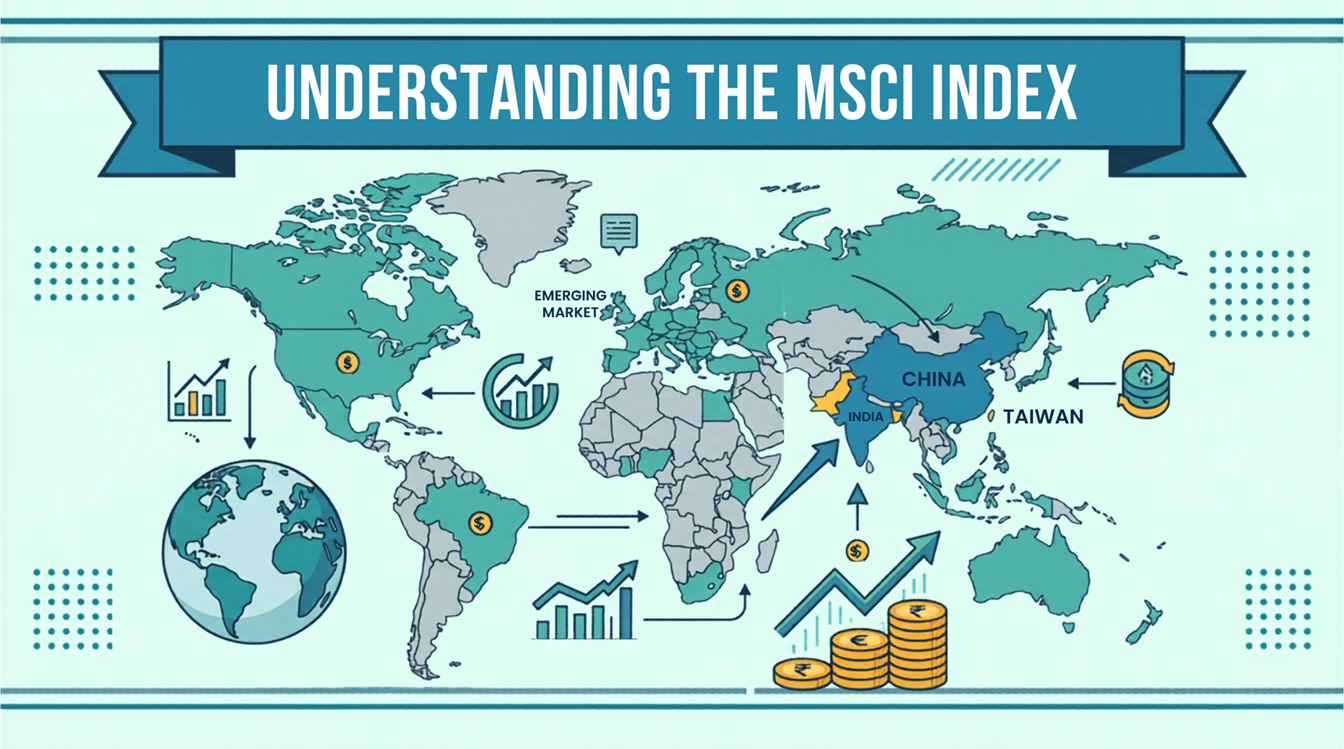
MSCI Index India Weightage & Emerging Market Impact For India, the MSCI Emerging Markets Index holds exceptional strategic importance. As one of the world's fastest-growing major economies, India has steadily expanded its footprint in global investment portfolios. International allocators looking for sustainable, long-term secular growth opportunities consistently route capital into Indian corporate leaders based on the official MSCI index India weightage.
Because such an enormous volume of foreign capital tracks these indexes, any changes in India's status or internal weightage can trigger massive shifts in foreign portfolio investments (FPI). Over the last decade, structural economic drivers such as rising corporate earnings, expanding market capitalization, digital transformation, and friendly foreign investor policies have structurally enhanced India's standing. Following recent 2026 reviews, India’s relative weight within the specific MSCI Emerging Markets Index has hovered around 12%, positioning it as a dominant force behind Taiwan, China, and South Korea.
Case Study: The MSCI Rebalancing May 2026 Review The most recent structural shift affecting Indian corporate equities occurred during the highly anticipated MSCI rebalancing May 2026 review, which officially became effective after the market close on May 29, 2026. This specific review triggered noticeable adjustments across several key Indian stocks and generated a massive spike in institutional trading activity.
Indian Additions to the MSCI Global Standard Index:
-
Federal Bank
-
Multi-Commodity Exchange of India (MCX)
-
National Aluminium Company (NALCO)
-
Indian Bank
These targeted additions successfully attracted fresh passive fund inflows as global managers updated their portfolios to buy matching stakes.
Indian Deletions from the MSCI Global Standard Index:
-
Hyundai Motor India
-
Jubilant FoodWorks
-
Kalyan Jewellers
-
Rail Vikas Nigam Limited (RVNL)
As anticipated by market analysts, these removed counters faced short-term technical selling pressure as index-linked funds wound down their equity holdings.
Conclusion: Focus on Financial Fundamentals. While tracking institutional capital flows through an index rebalance is an excellent exercise for understanding market liquidity, investors should avoid treating short-term index additions or deletions as definitive indicators of a company's long-term business viability. Inclusion in a major global benchmark may generate localized liquidity spikes and short-term price excitement, but sustainable wealth creation always depends on corporate governance, solid earnings visibility, competitive moats, and overall macroeconomic indicators.
As India continues to solidify its position as the world's premier fast-growing emerging economy, its long-term influence within global market benchmarks is structurally positioned to expand. Understanding how MSCI and its periodic rebalancing mechanisms function allows smart investors to appreciate how international capital flows increasingly shape the modern Indian financial ecosystem.
Optimize Your Portfolio for Global Market Shifts. Navigating institutional volatility, FII flows, and macroeconomic rebalancing requires sophisticated asset allocation. Let our certified team help you build a resilient, multi-asset strategy aligned with your personal risk tolerance and wealth goals.
Take control of your wealth strategy today. Click below to schedule a personalized portfolio audit and financial consultation with our advisory experts at Bonvista:
Book an Exclusive Call with Bonvista Financial Experts
Follow for daily updates: WhatsApp | LinkedIn | YouTube | Instagram | Facebook | X | Pinterest
Disclaimer: This article is for educational and informational purposes only and does not constitute financial or investment advice. Investors should consult with their certified financial planner or wealth manager before making any investment decisions. Mutual fund and gold investments are subject to market risks.

Mr. Unmesh Deshmukh
Founder & Director, Bonvista Financial Services | AMFI ARN: 136656
With over 24 years of elite experience in the financial services industry, Unmesh is a seasoned investment expert. He acts with a strict fiduciary mindset, leveraging data-backed strategies to help individuals and families create sustainable, generational wealth.
Connect on LinkedIn