
Bonvista Financial Services Pvt. Ltd. is an AMFI registered Mutual Fund Distributor holding ARN No.136656
Bonvista Financial Services Pvt. Ltd.
If you regularly follow Indian stock market news or track your personal investment portfolio, you have probably come across urgent headlines such as “FIIs sold Rs. 5,000 crore worth of equities today”, “FIIs sold Rs. 50,000 crore worth of equities in a month” or “Heavy FII selling drags markets lower.” These macroeconomic statements often create a lot of anxiety among everyday retail investors, especially when global market corrections cause domestic stock benchmarks to fall sharply.
But who exactly are these foreign institutional entities? Why do they choose to sell high-quality Indian stocks? Does heavy FII selling imply that something is fundamentally wrong with the Indian economy or corporate earnings growth? Most importantly, should retail investors, family offices, and wealth builders be worried whenever foreign investors pull short-term capital out of the domestic market?
Let us break down the core mechanics of foreign institutional flows in simple, jargon-free terms to help you make logical, data-driven decisions with your capital.
Who Are FIIs (Foreign Institutional Investors)?
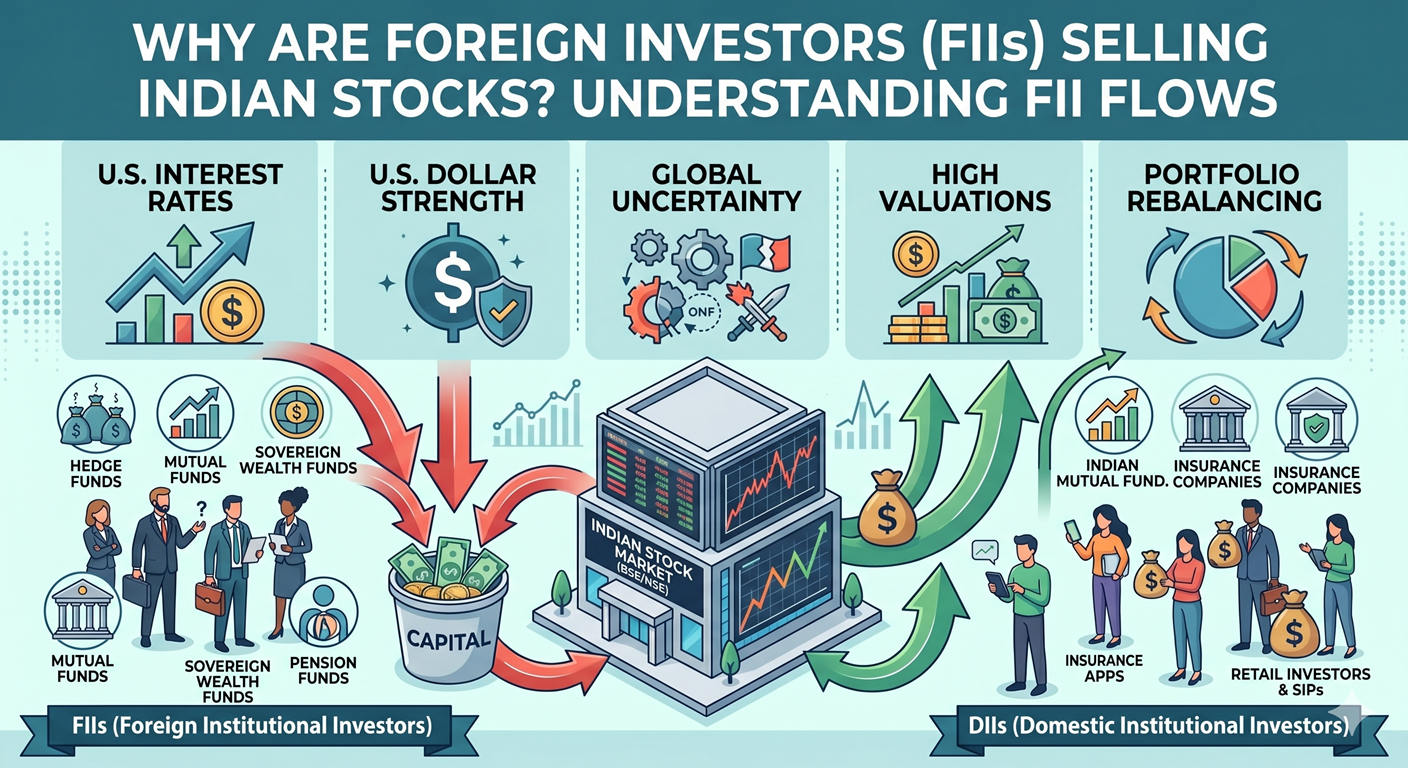
FII stands for Foreign Institutional Investor. In corporate finance, FIIs are large investment entities based entirely outside of India that actively pool global capital to invest in Indian financial markets. They operate on a massive scale and include prominent foreign mutual funds, international pension funds, global insurance conglomerates, sovereign wealth funds, hedge funds, and multi-national asset management companies (AMCs).
Due to their deep structural belief in India's long-term macroeconomic growth story, infrastructure development, and rising corporate profitability, several of the largest investment houses in the world allocate a specific portion of their global capital to Indian equities.
When FIIs actively buy and pump money into Indian stocks, domestic equity markets receive a heavy influx of additional liquidity, which rapidly boosts investor sentiment and drives valuations upward. On the flip side, when they systematically withdraw money or trim their exposure, stock prices naturally come under short-term pressure.
Why Are FII Flows Closely Tracked?
Because FIIs manage trillions of dollars globally, they control an enormous amount of highly liquid capital. Even a fractional change in their international asset allocation can spark significant daily movements in the Indian indices.
For example, if an elite global fund managing billions of dollars decides to reduce its overall exposure to emerging markets by a mere 1%, a substantial amount of money instantly flows out of countries like India. This is why financial analysts, mutual fund distributors, and active market participants closely monitor daily institutional buying and selling metrics.
However, a common misconception among retail investors is that foreign capital moves solely based on India's internal economic indicators. In reality, institutional capital moves dynamically based on global macro trends, cross-border interest rate differentials, and worldwide liquidity conditions.
Master the Markets with Paise ki Paathshala! Want to cut through complex financial jargon, track institutional cash flows, and receive daily market insights directly on your phone? Join our fast-growing WhatsApp learning community Paise ki Paathshala today to build your investment discipline: Join Paise ki Paathshala Now
The Real Reasons: Why Do FIIs Sell Indian Stocks?
1. Higher Interest Rates in the United States
One of the most common structural drivers behind extended FII selling is a rising interest rate cycle in developed economies, particularly the United States. When the US Federal Reserve increases interest rates, safe government bonds and US Treasury bills become highly attractive. Global investors realize they can lock in dependable, risk-free dollar returns with virtually zero capital volatility.
Consequently, foreign asset managers naturally move a portion of their capital out of higher-risk emerging markets like India and relocate it back into safe US-based assets. This routine capital migration does not mean India has suddenly become an inferior investment destination; it simply indicates that global institutions are reallocating money toward safer risk-adjusted opportunities elsewhere.
2. A Strengthening US Dollar Index (DXY)
The relative value of the US dollar plays a major role in global capital distribution. When the dollar index strengthens, global fund managers naturally prefer holding dollar-denominated assets. Furthermore, a rising dollar can actively erode the net returns earned from emerging markets once those gains are converted back into foreign currency.
For example, if a global fund earns a fantastic 10% return in Indian equities, but the Indian Rupee (INR) simultaneously weakens against the US Dollar (USD), the actual net return in absolute dollar terms diminishes. This inherent currency depreciation risk often triggers automated programmatic capital outflows from Indian markets.
3. Global Economic Uncertainty and "Flight to Safety"
Institutional investors tend to become deeply cautious during periods of macroeconomic distress. Structural events such as geopolitical tensions, international conflicts, regional banking crises, global supply chain inflation, or looming recession fears make global managers highly risk-averse.
During these volatile cycles, institutions execute a classic "flight to safety," shifting their capital out of volatile equities and placing it into cash, gold, or short-term US sovereign debt. As a result, emerging market portfolios face temporary, non-fundamental liquidation.
4. Expensive Market Valuations
Sometimes, FII selling is driven purely by technical asset valuation. When Indian stock markets undergo extended bull runs and trade at premium price-to-earnings (P/E) multiples relative to historical averages, foreign managers will deliberately book profits.
They exit overvalued segments to lock in gains and quietly wait for better technical entry points during future market corrections. This is standard investment behavior and shouldn't be mistaken for a negative outlook on India's underlying economic trajectory.
5. Systematic Portfolio Rebalancing
Large institutional funds operate under rigid, mandate-driven asset allocation frameworks. Suppose the Indian equity market significantly outperforms other international regions like Europe or Latin America. In that case, the mathematical weight of Indian stocks within a global fund's portfolio will naturally swell past its target limit.
To restore their mandatory risk balance, the fund is forced to sell down a portion of its Indian holdings and redistribute those proceeds into underperforming regions. Again, this is a routine portfolio management exercise rather than a sign of economic pessimism.
If FIIs Are Selling, Who Is Buying?
This is where the massive structural shift in the Indian financial landscape comes into play, highlighting the powerful rise of Domestic Institutional Investors (DIIs). DIIs comprise Indian mutual funds, domestic insurance companies, national pension funds, and major local financial institutions.
Over the past decade, the reliance on foreign capital has reduced drastically. The phenomenal rise of financial literacy among retail savers, backed by consistent monthly Systematic Investment Plan (SIP) contributions, has unlocked a continuous, reliable stream of domestic capital directly into equity mutual funds.
FII Outflows (Selling) (Global Macro, US Rates, Forex) ---> DII Inflows (Buying) (Retail SIPs, PF, LIC Inflows) ---> Market Resilience & Cushion (Reduced Short-Term Volatility)
When FIIs sell aggressively, strong local DIIs step in and absorb that selling pressure by purchasing those very same high-quality shares. This internal domestic liquidity pool is the exact reason why Indian equity markets have demonstrated spectacular structural resilience during recent global corrections compared to previous decades.
Does FII Selling Always Lead to a Market Crash?
Not necessarily. While heavy, concentrated FII selling can cause temporary waves of short-term volatility and minor index corrections, the long-term trajectory of the stock market is determined by core fundamentals: sustainable corporate earnings growth, domestic GDP expansion, system liquidity, and long-term investor sentiment. History shows numerous instances where foreign capital exited heavily, yet the markets fully recovered and surged to new highs, powered entirely by robust domestic participation and excellent business performance.
Actionable Guidelines for Retail Investors
The single biggest mistake a retail investor can make is reacting emotionally to daily institutional buying and selling data sheets. Successful wealth creation requires a long-term perspective.
When navigating macro capital shifts, keep these practical guidelines in mind:
-
Do Not Panic: Avoid making impulsive portfolio liquidations just because foreign funds are trading short-term blocks of equity.
-
Maintain Your SIP Discipline: Continue your automated monthly mutual fund allocations during volatile phases to benefit from rupee cost averaging.
-
Enforce Strategic Asset Allocation: Ensure your wealth is mathematically distributed across a balanced mix of equity, fixed-income debt, gold, and liquid cash based on your risk capacity.
-
Focus on Quality Fundamentals: Rely on verified corporate earnings data and trusted professional insights rather than dramatic daily news headlines.
-
Capitalize on Corrections: Treat temporary, FII-driven market dips as excellent strategic opportunities to review your portfolio and accumulate quality assets at a relative discount.
Remember, institutional managers operate with entirely different timelines, hedging requirements, and risk benchmarks than an individual retail investor or a family office building long-term generational wealth.
The Bottom Line: Focus on the Long-Term Story
FII buying and selling is a standard, healthy feature of globalized financial markets. Foreign entities will continue to rotate capital based on a complex web of international factors: from shifting US Treasury yields and dollar movements to global risk variations and standard asset rebalancing.
An institutional exit does not imply that India's fundamental growth story is broken. The domestic investment landscape is stronger than ever, anchored by compounding retail savings, robust regulatory frameworks, and powerful local DII participation. For smart wealth builders, the lesson is straightforward: track macro flows to understand the market's texture, but never let them derail your personalized financial blueprint.
Secure a Professional Audit for Your Wealth Setup
Navigating global volatility and positioning your capital across mutual funds, PMS, or specialized funds requires continuous alignment. Let our certified wealth management advisory team review your asset allocation structure to protect your long-term wealth milestones.
Take control of your portfolio management. Contact our expert advisory team directly at +91 8390040100 or click below to schedule an exclusive financial planning consultation with Bonvista today:
Book Your Professional Portfolio Consultation with Bonvista Experts
Follow for daily updates: WhatsApp | LinkedIn | YouTube | Instagram | Facebook | X | Pinterest
Disclaimer: This article is for educational and informational purposes only and does not constitute financial or investment advice. Investors should consult with their certified financial planner or wealth manager before making any investment decisions. Mutual fund and gold investments are subject to market risks.

Mr. Unmesh Deshmukh
Founder & Director, Bonvista Financial Services | AMFI ARN: 136656
With over 24 years of elite experience in the financial services industry, Unmesh is a seasoned investment expert. He acts with a strict fiduciary mindset, leveraging data-backed strategies to help individuals and families create sustainable, generational wealth.
Connect on LinkedIn