
Bonvista Financial Services Pvt. Ltd. is an AMFI registered Mutual Fund Distributor holding ARN No.136656
Bonvista Financial Services Pvt. Ltd.
What is EGR?
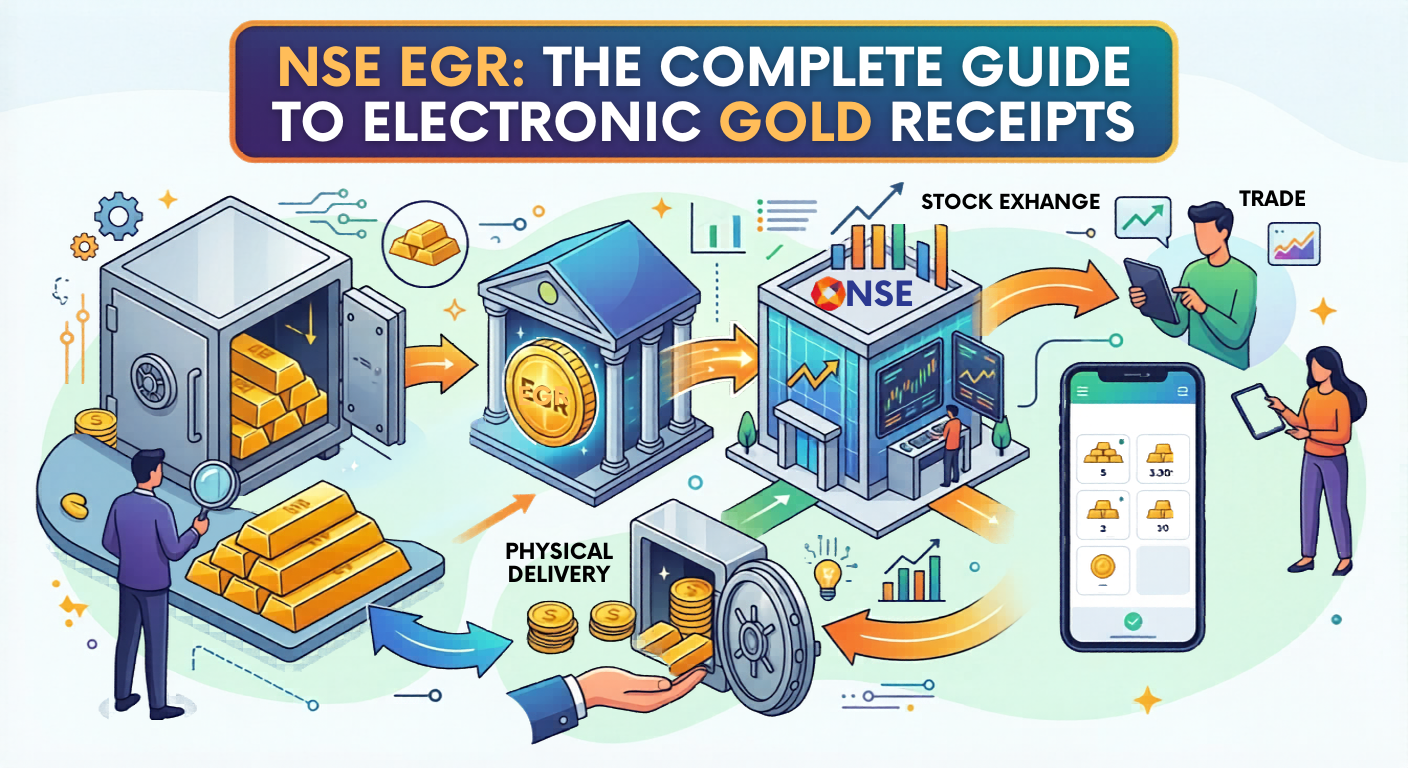
EGR is Electronic Gold Receipt. It is a dematerialized security that represents physical gold ownership, which is stored in authorized vaults. Instead of purchasing gold jewellery or coins and keeping them physically, investors can buy EGRs through the stock exchange and hold them in their demat account, similar to stocks.
Each EGR is backed by actual gold of specified purity stored in SEBI-approved vaults. Investors can trade these receipts on the exchange and may also convert them into physical gold, subject to prescribed conditions.
To put it simply, an EGR acts as ownership documentation for actual gold without requiring the investor to hold it.
It was introduced recently by the National Stock Exchange (NSE).
Trading of EGR:
The National Stock Exchange of India has commenced trading in EGR from 18th May 2026, marking a major step toward formalizing and digitizing India’s gold investment ecosystem.
The launch comes after the Securities and Exchange Board of India (SEBI) approved the NSE's earlier this month introduction of the EGR segment.
NSE has introduced EGR products across different purity standards and denominations, including:
- 999 purity gold
- 995 purity gold
- 100 grams contracts
- 10 grams contracts
- 1 gram contracts
- Smaller denominations such as 100 milligrams
How Electronic Gold Receipts Work?
Vault managers, depositories, exchanges, and clearing companies are all part of the regulated EGR ecosystem.
Procedure in detail:
- Physical gold is kept in vaults approved by SEBI.
- The quantity and purity of the gold are confirmed by the vault manager.
- A demat-formatted electronic gold receipt is issued.
- Like other securities, the EGR can then be traded on the NSE platform.
- EGRs can also be exchanged for actual gold by investors.
How to Invest in EGRs?
Investors who wish to trade EGRs (Electronic Gold Receipts) will require a demat account and trading account linked to an NSE-registered broker.
Investors can acquire EGRs on their trading platforms in the same way that they can buy shares or ETFs once trading starts. After settlement, the investor's demat account will show the EGR units.
Subject to the operational framework of the exchange and vault manager, investors may also decide to convert their eligible EGR holdings into actual gold in the form of gold bars or coins.
Details of Trading of NSE EGR:
As per the framework, the trading platform is the National Stock Exchange. Market Timings are Monday to Friday – 9:00 am to 11:30 pm / 11:55 pm*, (* based on the US daylight saving time period). The settlement cycle is T+1.
Retail investors, jewellers, bullion traders, refineries, etc., are the Market participants.
What is the difference between EGR, Gold Mutual Funds & Gold ETFs?
|
Basis |
NSE EGR (Electronic Gold Receipt) |
Gold ETF |
Gold Mutual Fund |
|
Meaning |
Digital receipt representing ownership of physical gold stored in authorized vaults |
An exchange-traded fund investing mainly in physical gold |
Mutual fund investing primarily in Gold ETFs |
|
Form of Holding |
Held in a demat account as electronic gold receipts |
Held in a demat account like shares |
Held as mutual fund units |
|
Backing |
Directly backed by physical gold |
Backed by physical gold managed by AMC |
Indirect exposure through Gold ETF |
|
Purchase Mode |
Bought through the stock exchange |
Bought through the stock exchange |
Bought from AMC or an investment platform |
|
Demat A/c. |
Required |
Required |
Not compulsory |
|
Pricing Method |
Based on the gold market price and exchange trading |
Based on the ETF market price and NAV |
Based on daily NAV |
|
Liquidity |
Traded on the exchange during market hours |
Traded on the exchange during market hours |
Redeemed through AMC |
|
Expense Ratio |
Very low or minimal |
Moderate expense ratio |
Higher due to additional fund expenses |
|
Physical Delivery |
Possible subject to conditions |
Generally, not available for retail investors |
Not available |
|
Trading Flexibility |
High |
High |
Limited to end-of-day NAV |
|
Tracking Error |
Very low |
Possible due to expenses and cash holdings |
Slightly higher because the fund invests in ETFs |
|
SIP Facility |
Generally, not available |
Possible through broker platforms |
Easily available |
|
Best suited for |
Investors seeking direct electronic ownership of gold |
Investors prefer exchange-traded gold investments |
Investors wanting a simple gold investment without a demat account |
|
Main Advantage |
Closest to owning actual gold digitally |
Easy intraday trading |
Convenient for small and SIP investors |
|
Main Limitation |
Requires demat and exchange participation |
Requires a demat and brokerage account |
Higher overall cost |
You can invest in Gold in any form as per your risk, priority and objective.
Don't just guess your Wealth Health. Use our Interactive Peace of Mind Scorecard to see how you are doing with your finances.
Want to stay ahead of the market? Join 300+ investors in our 'Paise ki Paathshala' WhatsApp community for weekly simplified insights on tax-saving, wealth-building, trending news, and mutual fund tips.
Join the Community | Book a Free Portfolio Review | Contact our Experts
Follow for daily updates: WhatsApp | LinkedIn | YouTube | Instagram | Facebook | X | Pinterest
Disclaimer: This article is for educational and informational purposes only and does not constitute financial or investment advice. Investors should consult with their certified financial planner or wealth manager before making any investment decisions. Mutual fund and gold investments are subject to market risks.

Mr. Unmesh Deshmukh
Founder & Director, Bonvista Financial Services | AMFI ARN: 136656
With over 24 years of elite experience in the financial services industry, Unmesh is a seasoned investment expert. He acts with a strict fiduciary mindset, leveraging data-backed strategies to help individuals and families create sustainable, generational wealth.
Connect on LinkedIn