

Bonvista Financial Services Pvt. Ltd. is an AMFI registered Mutual Fund Distributor holding ARN No.136656
Bonvista Financial Services Pvt. Ltd.
For Indian households, gold is much more than just a precious metal. It is an investment, a symbol of financial security and an important part of weddings, festivals and family traditions. From purchasing gold jewellery during Diwali and Dhanteras to accumulating gold coins for future needs, Indians have traditionally trusted gold as a store of wealth.
Over the past few years, gold has also attracted considerable attention from investors looking to diversify their portfolios and protect their wealth against inflation and global uncertainty.
However, 2026 has delivered a surprising lesson to gold investors.
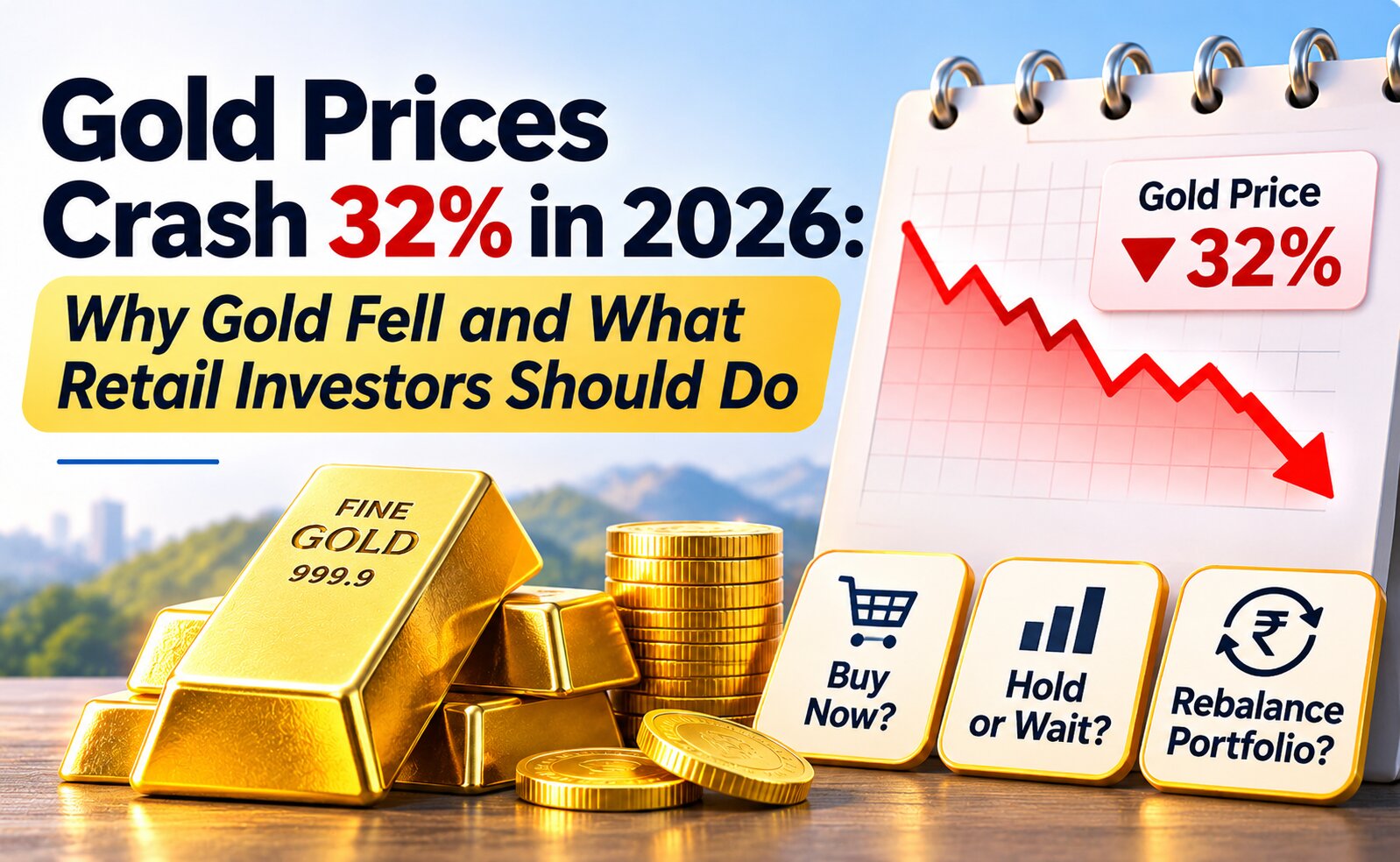
After reaching record levels in January 2026, gold prices witnessed a sharp correction. By November 20, 2026, the price had fallen approximately 32% from its January peak.
Portfolio Impact Snapshot: For someone who invested Rs. 10 lakhs in gold near its peak, his portfolio value would be Rs. 6.80 Lakhs approximately.
A decline of this magnitude naturally raises concerns among investors. Is the golden rally finally over? Was the earlier rise driven by genuine demand or excessive optimism? And more importantly, should Indian investors consider this correction an opportunity to purchase gold at lower prices?
Let's understand the reasons behind the fall and what this means for ordinary investors.
Key Takeaways (Quick Summary)
The 2026 Correction: Illustrative gold prices dropped approximately 32.2%, moving from Rs. 1,80,000 per 10 grams in January 2026 to Rs. 1,22,000 by November 20, 2026.
Why Gold Fell: A stronger US dollar, higher-for-longer interest rates and bond yields, heavy profit booking after a rapid rally, and shifting global investor sentiment drove the decline.
Historical Context: Major gold corrections in 1980 (57%), 1996 (31%), and 2012 (29%) took anywhere from roughly 2 years 10 months to over 7 years to recover.
Action Plan for Retail Investors: Avoid timing the exact bottom, stagger deployments, stick to disciplined asset allocation (such as ~15% portfolio exposure), prefer investment formats like Gold ETFs over jewellery for investment goals, and never borrow to buy gold.
From Record Highs to a Sharp Correction: What happened to Gold?
Before reaching its peak in January 2026, Gold delivered an extraordinary rally. However, the direction changed sharply during the subsequent months.
Consider the following approximate price movement:
| Particulars | Gold price per 10 grams |
| January 2026 peak | Rs. 1,80,000/- |
| November 20, 2026 | Rs. 1,22,000/- |
| Approximate decline | 32.2% |
Note: These are illustrative reported market levels. Actual retail prices vary according to purity, location, taxes and applicable charges.
The Math of Recovery: If an investment falls by 32%, it must subsequently rise by approximately 47% to recover its original value. Therefore, recovering from a major correction is not as easy as simply waiting for an equivalent percentage increase.
Why Did Gold Prices Fall So Sharply?
Many investors believe that gold prices should always increase whenever there is global uncertainty. However, gold prices are influenced by several factors, and sometimes these factors work against each other.
Let's understand the major reasons behind the correction.
1. Stronger US Dollar
Gold is internationally traded in US dollars. Therefore, movements in the dollar can significantly influence gold prices.
When the US dollar strengthens against other currencies, gold generally becomes more expensive for investors holding those currencies. This can reduce demand and put pressure on international gold prices.
For Indian investors, currency movements tracked by the Reserve Bank of India (RBI) add another dimension. Even when international gold prices decline, a weaker Indian rupee can partially offset the fall in domestic gold prices.
2. Interest Rates and Bond Yields
Gold does not generate regular income like a fixed deposit or a bond. Suppose an investor has Rs. 5 lakhs and is deciding between investing in gold and a fixed deposit.
A bank FD may provide a predictable interest income, whereas gold generates a return only if its market price increases.
When interest rates and bond yields become attractive, some investors may prefer interest-bearing investments over gold. This is particularly relevant when expectations of interest-rate cuts from the US Federal Reserve decline or interest rates are expected to remain higher for longer. This is what is exactly happening currently.
3. Profit Booking After a Strong Rally
One of the simplest explanations for a sudden market correction is profit booking.
Imagine an investor purchased gold at Rs. 80,000 per 10 grams and saw its price rise to Rs. 1,80,000. The investor may decide to sell and secure substantial profits rather than wait for further appreciation.
When many investors follow the same approach, selling pressure increases and prices can fall rapidly. A decline may then encourage other investors to sell, creating further downward pressure.
4. Changing Global Investment Sentiment
Gold is often considered a safe-haven investment during economic and geopolitical uncertainty. However, this relationship is not automatic.
Investors also consider inflation expectations, interest rates, the US dollar, bond yields, and the availability of alternative investment opportunities.
If market participants expect stronger returns from other assets or believe monetary conditions will remain restrictive, gold may lose some of its investment appeal. In other words, global uncertainty alone is not sufficient to guarantee rising gold prices.
Have We Seen Such Gold Prices Before?
One important mistake investors make is assuming that gold prices will quickly recover whenever they decline.
History tells a different story.
Gold has experienced several major corrections, and in some cases investors had to wait years before prices recovered to their previous highs.
| Historical period | Approximate correction | Recovery period |
| 1980 correction | 57% | Around 7 years 5 months |
| 1996 correction | 31% | Around 2 years 10 months |
| 2012 correction | 29% | Around 6 years 7 months |
Historical figures are approximate and based on reported historical peak-to-recovery periods.
These examples highlight an important point. Gold may be a long-term store of value, but it is not immune to prolonged periods of weak performance.
An investor who purchased gold at a market peak may have to remain invested for several years before recovering the initial investment. Past corrections do not predict the duration or magnitude of the current correction.
Having said that, history also tells us that bull runs of gold last for the longer-term.
Example:
| Period | Market movement | Approx. price change | Key takeaway |
| 1976–1980 | Bull run | +541% | Strong multi-year rally |
| 2001–2011 | Bull run | +612% | Exceptional decade-long rally |
| 2019–2025 | Bull phase | Positive in each year | Strong multi-year appreciation |
Nevertheless, they remind investors that patience and an appropriate investment horizon are important.
Should Indian Investors Buy Gold After the Crash?
This is probably the most common question among retail investors.
Someone who was waiting for an opportunity to purchase gold may now see the correction as an attractive entry point. Meanwhile, investors who purchased at higher prices may be wondering whether they should average their investments.
There is no guaranteed answer because nobody can accurately identify the bottom of the market. However, investors can consider the following approaches.
1. Avoid Trying to Time the Exact Bottom
Suppose an investor has Rs. 2 lakhs available for gold investment.
Instead of investing the entire amount immediately, the investor could divide the investment into smaller portions and deploy it gradually over a predetermined period. This approach reduces the risk of committing the entire amount just before another decline.
2. Review Your Overall Portfolio Allocation
Gold should ideally serve a purpose within an investment portfolio rather than become the only source of wealth creation.
Assume that you have 15% Gold in the portfolio. If gold prices rise sharply, its share of the portfolio may increase. Similarly, after a major correction, its proportion may decline.
Investors should periodically review their asset allocation through a structured goal-based investing approach rather than continuously chase whichever asset class has delivered the highest recent returns. If you are unsure how much volatility your portfolio can comfortably absorb, start with our quick 2-minute Investment Risk Profiler.
3. Understand the Difference Between Jewellery and Investment Gold
Many Indian households purchase gold jewellery considering it an investment. However, jewellery involves making charges, possible wastage charges and differences in resale value.
For someone whose primary objective is investment rather than personal use, alternatives such as gold ETFs (traded on exchanges like the NSE India) or gold mutual funds (learn more about fund categories on AMFI India) may be worth understanding.
These products provide exposure to gold prices without requiring the investor to store physical jewellery. Before investing, however, investors should examine the objective of investment, expense ratios, tracking differences, liquidity and applicable taxation.
4. Do Not Borrow Money to Invest in Gold
A falling market can tempt investors to make large purchases in the hope of earning quick profits during a recovery.
However, borrowing money to invest in a volatile asset can increase financial stress. Gold prices may remain weak for an extended period, whereas loan repayments and interest obligations continue regardless of market performance.
Investments in gold should therefore be made with surplus funds and with an appropriate investment horizon.
What Could Influence Gold Prices Going Forward?
Predicting the exact direction of gold prices is difficult. However, investors can monitor a few important indicators:
-
US Federal Reserve policy: Changes in US interest rates and expectations regarding future rate cuts from the Federal Reserve can influence gold demand.
-
US dollar movement: A stronger dollar can create pressure on international gold prices, while dollar weakness may provide support.
-
Central bank purchases: Demand from central banks, tracked globally by the World Gold Council, can influence the long-term gold market.
-
Geopolitical developments: International conflicts and economic uncertainty can increase safe-haven demand.
-
Indian rupee movement: Domestic gold prices are also influenced by the exchange rate between the US dollar and Indian rupee.
Investors should remember that these factors do not operate independently. Gold prices reflect the combined impact of several economic and market developments.
The Biggest Lesson For Retail Investors
The 2026 gold correction offers an important lesson to investors who tend to invest in an asset after observing extraordinary returns.
When gold prices were continuously reaching new highs, many investors may have felt that waiting would mean missing an opportunity. But when prices corrected sharply, the same investors started questioning their decisions.
This behaviour is not limited to gold. It can also be observed in equity markets, real estate, cryptocurrencies and other investment categories. Investors often become optimistic after an asset has already delivered strong returns and become fearful when its price starts declining.
A more sensible approach is to decide why an asset is being purchased, how much exposure is appropriate and how long the investment can be held. An investment should be selected based on its role in the overall financial plan, not simply because its price has increased significantly in the recent past.
Gold continues to have an important role in portfolio diversification and wealth preservation. At the same time, investors must understand that its market price can fluctuate considerably.
After all, gold may shine for years, but that does not mean its price will never fall.
Rebalance Your Portfolio Around Real Life Goals
Don't let short-term commodity or market swings derail your family's long-term milestones. Map your asset allocation across equity, hybrid, debt, and gold cleanly using our free online tools:
Calculate your target milestones with our Financial Goal Planner
Structure long-term post-work cash flow with our Retirement Goal Planning Guide
Check your comfort with market volatility using our Investment Risk Profiler
Frequently Asked Questions
Why did gold prices drop by around 32% in 2026? Illustrative gold prices fell roughly 32.2% from Rs. 1,80,000 per 10 grams in January 2026 to Rs. 1,22,000 by November 20, 2026 due to a combination of a stronger US dollar, attractive interest rates and bond yields, heavy profit booking after a rapid rally, and shifting global investment sentiment.
How much does gold need to rise to recover from a 32% fall? If an investment declines by 32%, it must rise by approximately 47% from the lower level just to return to its original value.
How long have major gold crashes taken to recover historically? Historical peak-to-recovery cycles show that recovery can take several years: the 1980 correction (57%) took around 7 years 5 months, the 1996 correction (31%) took around 2 years 10 months, and the 2012 correction (29%) took around 6 years 7 months.
Is it better to invest in physical gold jewellery or Gold ETFs? Physical gold jewellery carries making charges, possible wastage charges, and resale value differences. For investors whose primary objective is portfolio allocation rather than personal use, Gold ETFs offer price exposure without physical storage hassles, though investors should review expense ratios, tracking differences, liquidity, and taxation before investing.
Connect With Our Wealth Experts
Ready to transition from reactive saving to strategic wealth creation? Let our certified team assist you with expert Portfolio Management Services (PMS), high-alpha AIF advisory, and comprehensive retirement planning.
-
Book a Consultation: Book a meeting with us for genrational wealth creation
-
Call Us: +91 8390040100
-
Chat With Us: +91 8390040200
-
Visit Us: 506, Business Galaxy Building, Opp. Gokul Hotel, Beside Box Cricket, Kute Marg, Tidke Colony, Nashik, Maharashtra 422002
Follow for daily updates: WhatsApp | LinkedIn | YouTube | Instagram | Facebook | X | Pinterest
Disclaimer: This article is for educational and informational purposes only and does not constitute financial or investment advice. Investors should consult with their certified financial planner or wealth manager before making any investment decisions. Mutual fund and gold investments are subject to market risks.
Disclosure: Bonvista Financial Services Pvt. Ltd. is an AMFI Registered Mutual Fund Distributor holding ARN 136656

Mr. Unmesh Deshmukh
Founder & Director, Bonvista Financial Services | AMFI ARN: 136656
With over 24 years of elite experience in the financial services industry, Unmesh is a seasoned investment expert. He acts with a strict fiduciary mindset, leveraging data-backed strategies to help individuals and families create sustainable, generational wealth.
Connect on LinkedIn




Disclaimer: Mutual Fund investments are subject to market risks, read all scheme related documents carefully.
Bonvista Financial Services Pvt. Ltd. is an AMFI-Registered Mutual Fund Distributor (ARN: 136656). Any investment guidance provided is strictly incidental to our primary mutual fund distribution activity.