
Bonvista Financial Services Pvt. Ltd. is an AMFI registered Mutual Fund Distributor holding ARN No.136656
Bonvista Financial Services Pvt. Ltd.
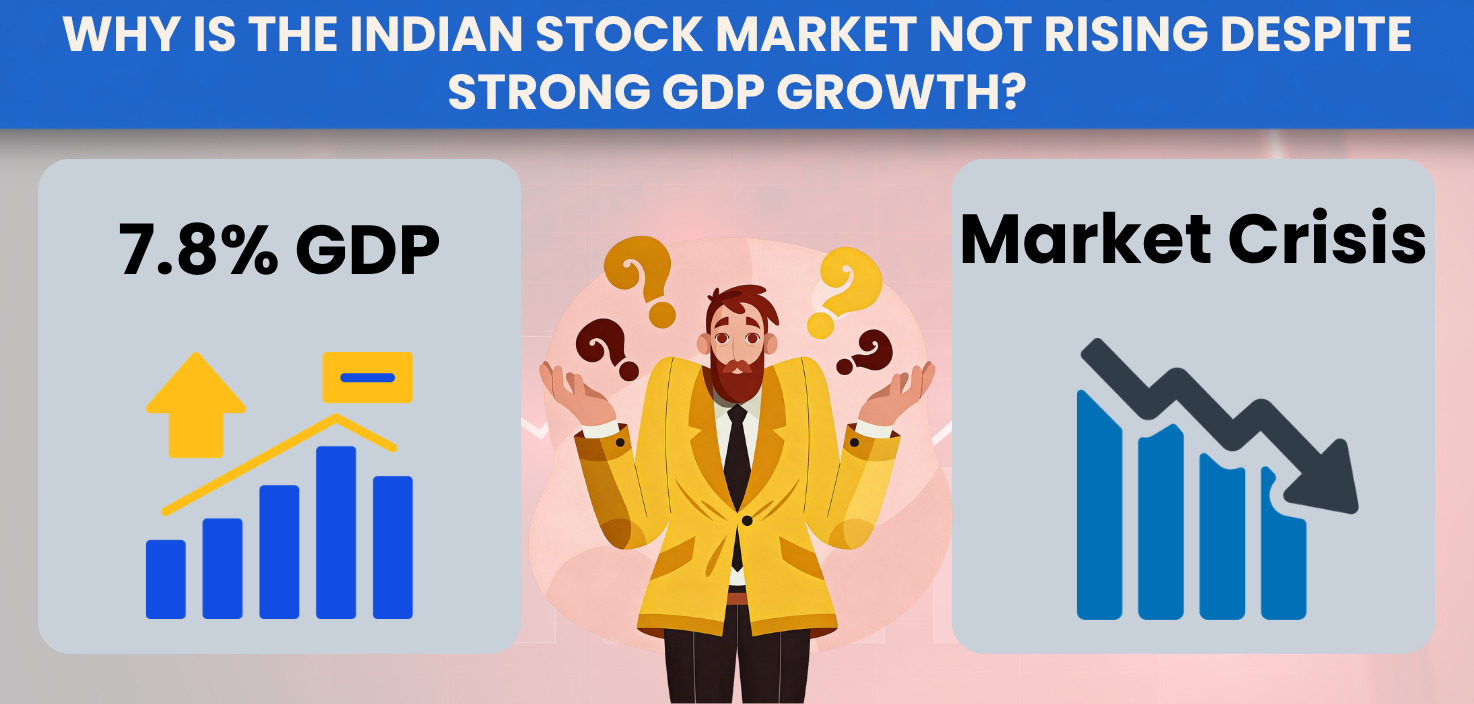
Why Is the Indian Stock Market Not Rising Despite Strong GDP Growth?
Recent data showed that India's GDP grew by 7.8% in the April-June 2026 quarter, exceeding many expectations. Manufacturing, services, investment, and domestic demand have all contributed to the country's economic momentum.
Now, here comes the question. “Why Is the Indian Stock Market Not Rising Despite Strong GDP Growth?” India’s economy is growing strongly. So why isn't the stock market always moving higher? As a trusted provider of wealth management in Nashik and across Maharashtra, our advisory team at Bonvista Financial Services frequently fields this exact question from concerned investors.
India's economy is growing at a strong pace. At first glance, this should be excellent news for the stock market. After all, if the economy is growing, businesses should sell more products, earn higher profits and expand their operations. That should eventually support higher share prices.
But the stock market does not always work that simply. There are periods when the Indian economy is growing strongly, yet the Nifty and Sensex remain flat, volatile or even fall.
This creates an important question: If India's GDP is growing strongly, why isn't the stock market always rising?
The simple answer is that GDP growth and stock-market returns are connected, but they are not the same thing. Let's understand why. Navigating this disconnect is exactly why structured goal-based investing is critical for long-term wealth creation.
GDP Growth Doesn’t Directly Equal Stock-Market Returns
GDP measures the total value of goods and services produced in an economy. The stock market, however, represents the value investors are willing to pay for the future earnings of listed companies.
This means: Strong GDP growth is NOT Equal to Strong stock-market returns.
A country's economy can grow rapidly while stock-market returns remain weak or moderate. The reason is that stock prices depend on several factors:
-
Corporate earnings
-
Valuation of the Company
-
Interest rates in the country
-
Liquidity scenario
-
Investor expectations
-
Global economic conditions
GDP growth is only one part of the picture.
The Stock Market Looks at the Future, Not Just Today's GDP
One of the most important things investors need to understand is that the stock market is forward-looking. Share prices often move based on what investors expect to happen over the next one or two years.
Suppose India's GDP grows by 7%. That sounds positive. But imagine investors were already expecting 8% growth. The actual number may be strong, but it may still disappoint expectations.
Similarly, imagine GDP grows strongly today, but investors expect:
-
Higher crude oil prices
-
Rising interest rates
-
Slower global growth
-
Weak corporate earnings next year
The stock market may remain cautious. This is because the market is constantly trying to answer: “What will happen next?” instead of “What happened today?”
GDP Growth Doesn’t Always Become Corporate Profit Growth
This is perhaps the most important reason. A growing economy does not automatically mean that all listed companies will earn higher profits. Consider an example.
India's GDP may grow because of:
-
Government spending
-
Infrastructure construction
-
Agricultural production
-
Small businesses
-
Unlisted companies
-
Public services
But not all of this growth directly increases the profits of companies listed on the stock exchange. For the stock market to rise sustainably, investors generally want to see strong growth in:
-
Revenue
-
Profit margins
-
Net profit
-
Earnings per share
GDP growth can create a favourable environment, but ultimately listed companies need to convert economic growth into actual profits.
The good news is that corporate earnings have recently shown improvement. Nifty 50 companies reported strong profit growth in the June 2026 quarter, with average profit growth reaching an estimated 18%, the highest in 10 quarters, according to brokerage estimates.
However, markets also look at whether such earnings growth can continue. For high-net-worth investors in wealth hubs, this highlights the importance of expert Portfolio Management Services (PMS) and Alternative Investment Funds (AIFs) to identify specific companies driving real profit growth, rather than relying solely on the broader index.
Strong GDP Growth May Already Be Priced Into the Current Market Price
This is a very important concept. Imagine everyone already knows that India's economy is growing rapidly. Investors buy shares in anticipation of:
-
Strong consumption
-
Higher corporate profits
-
Infrastructure spending
-
Manufacturing growth
-
Rising incomes
As a result, stock prices may already rise before the actual GDP data is released. Then, when strong GDP numbers finally arrive, there is no surprise. The news was already reflected in stock prices. This is why a market can sometimes fall even after positive economic data.
The market does not react only to whether the news is good or bad. It reacts to whether the news is better or worse than expectations.
Valuation Matters
A strong economy can still have an expensive stock market. Suppose a company's earnings are Rs. 100 per share. If investors are willing to pay Rs. 2,000 for that share: P/E = 20.
Now imagine earnings rise to Rs. 110. That is good news. But what if investors become less optimistic and are willing to pay only a P/E of 17?
The new share price would be: Rs. 110 × 17 = ₹1,870.
So, despite earnings growing from Rs. 100 to Rs. 110, the stock price falls from Rs. 2,000 to Rs. 1,870. This is called valuation compression. The same principle applies to an entire stock market.
India may have strong GDP growth and growing corporate profits, but falling valuation multiples, and as a result, stock-market returns can remain weak. To navigate these valuation traps, sophisticated investors often utilize Specialised Investment Funds (SIFs) to target pockets of value and protect their downside risk.
Global Factors Can Overpower Domestic Growth
India is a growing economy, but Indian financial markets are connected to the rest of the world. This means that global events can influence Indian share prices. Recent market volatility has been linked to factors including:
-
Rising crude oil prices
-
Global bond yields
-
US monetary-policy expectations
-
Geopolitical tensions
-
Foreign investor flows
Even with strong domestic economic data, these global factors can affect investor sentiment and risk appetite. For example, rising oil prices can be particularly important for India because the country is a major importer of crude oil. Higher crude prices can affect Inflation, Import costs, corporate profit margins, Interest-rate expectations, and investor sentiment. That can put pressure on the stock market even when GDP growth remains strong.
Foreign Investor Flows Still Matter
Domestic investors have become increasingly important in the Indian market. Mutual funds, SIPs, and domestic institutional investors can provide significant support during periods of foreign selling. In August 2026, SIP contributions reached a record Rs. 322.97 billion, while equity mutual-fund inflows remained strong despite market volatility. As an AMFI-registered Mutual Fund & SIF Distributor, we actively guide our clients to maintain their SIP discipline through these exact volatile periods to maximize long-term compounding.
But foreign investors still matter. When global investors reduce exposure to India, their selling can create pressure on large-cap stocks and overall market sentiment. Foreign investors compare India with other markets. They consider Valuation, Currency, Interest rates, Economic growth, corporate earnings, Global risks, and Opportunities in other countries.
High Oil Prices Can Hurt India
India imports a large portion of the crude oil it consumes. Therefore, a sharp increase in crude prices can create multiple challenges. Higher crude oil means a higher import bill, pressure on the rupee, higher inflation risk, pressure on corporate costs, and a possible impact on interest rates. Recent market weakness has been closely linked to elevated crude prices and geopolitical risks in West Asia.
Conclusion
GDP tells us how the economy is growing. Corporate earnings tell us how businesses are performing. Valuation tells us what investors are paying for those earnings. Together, these factors help explain the direction of the stock market.

Mr. Unmesh Deshmukh
Founder & Director, Bonvista Financial Services | AMFI ARN: 136656
With over 24 years of elite experience in the financial services industry, Unmesh is a seasoned investment expert. He acts with a strict fiduciary mindset, leveraging data-backed strategies to help individuals and families create sustainable, generational wealth.
Connect on LinkedIn