
Bonvista Financial Services Pvt. Ltd. is an AMFI registered Mutual Fund Distributor holding ARN No.136656
Bonvista Financial Services Pvt. Ltd.
Let's understand the Characteristics:
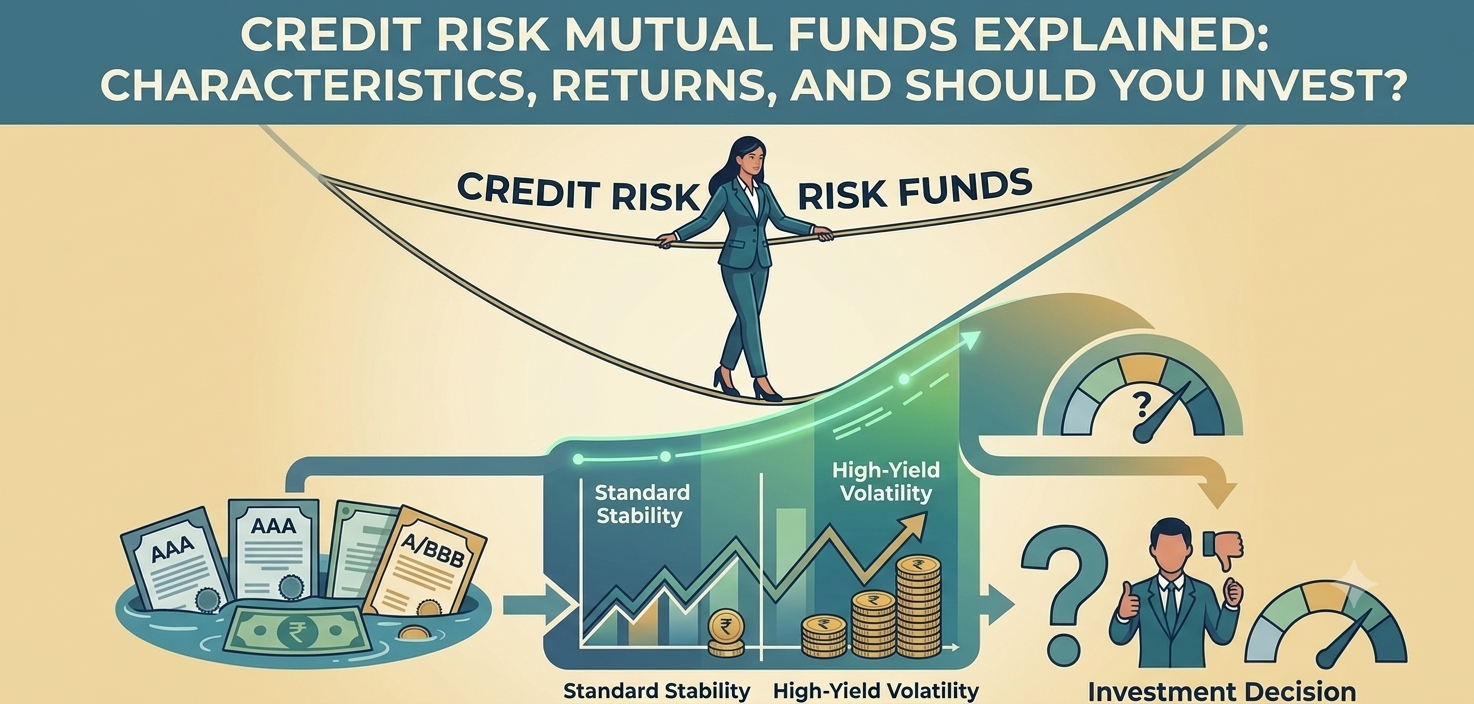
In India, under SEBI's mutual-fund categorisation, a Credit Risk fund is the Fund which invests at least 65% of its portfolio in corporate bonds rated AA and below (excluding AA+ rated securities). The idea is to earn returns from both interest income and potential credit-rating upgrades, but the fund also faces a higher risk of default/downgrade. Understanding these SEBI guidelines for debt mutual funds is crucial for building a well-diversified investment portfolio.
Credit-risk funds delivered around an average of 7.30% p.a. returns over three years, with some individual schemes delivering significantly higher returns. According to recent debt market data, the yield to maturity (YTM) on lower-rated securities often outperforms standard banking and PSU funds, driving this competitive 3-year trailing performance.
The recent performance has been supported by favourable credit-market conditions, including relatively healthy corporate balance sheets, lower leverage in several segments and improved investor sentiment toward corporate credit.
However, there is a greater degree of risk associated with the outstanding returns. Credit-risk funds expose investors to the risk of downgrades, defaults, and liquidity stress by investing in lower-rated corporate bonds in order to produce greater yields.
Experts advise investors contemplating the category in light of its recent performance to go beyond returns and comprehend how those profits were produced. Evaluating the fund manager's strategy and the fund's expense ratio is just as important as looking at historical capital gains.
| Credit Risk Fund | 3-year trailing returns, Regular Growth plans, as on 04.09.2026 |
|---|---|
| DSP Credit Risk Fund | 15.92% |
| Aditya Birla Sun Life Credit Risk Fund | 12.23% |
| Bank of India Credit Risk Fund | 9.68% |
As shown in the table above, returns vary widely. It highlights an important characteristic of Credit Risk Funds. Two funds in the same category can have very different portfolios, credit quality, duration, concentration, and security selection. Therefore, investors should not select a Credit Risk Fund only because the category has performed well.
Learn Financial Concepts Without the Noise
Want to simplify complex market metrics, mutual fund concepts, and goal-based strategies?
Join our investor community on WhatsApp: Join Paise Ki Paathshaala for practical, educational insights to support your wealth journey.
According to experts, Credit-risk funds benefited from a favourable credit cycle over the past three years.
While concerns about defaults declined, corporate balance sheets grew stronger, leverage decreased, and profitability increased. Credit spreads narrowed as a result, giving funds holding lower-rated bonds substantial gains.
Due to its exposure to AA-rated and below-rated assets, the category also continued to generate comparatively large accrual income. Returns were increased by the combination of increased carry and spread compression gains. This spread compression essentially means the risk premium demanded by investors shrank, leading to mark-to-market capital gains for existing bondholders.
The extra returns come with higher credit and liquidity risk: The return should not be interpreted as a comparable return from a low-risk debt investment.
As the Credit-risk funds are required to invest at least 65% of their portfolio in corporate bonds rated AA and below, the strategy is therefore explicitly designed to take additional credit risk in return for potentially higher yields.
In contrast, short-duration funds have more stringent duration requirements, while corporate bond and banking & PSU funds typically have more exposure to higher-quality issuers.
When an issuer defaults or is downgraded, credit-risk funds may also see significant changes in NAV (Net Asset Value). Therefore, even though the underlying investments are debt instruments, investors must be ready for unpredictable volatility. If you are wondering why debt funds can lose money, it is precisely because of these sudden NAV drops caused by credit rating downgrades or rising interest rates.
The category should normally be avoided by conservative investors, retirees looking for capital stability, and those making short-term financial investments.
Key Risks:
-
Default Risk: The company issuing the bond may fail to pay interest or principal.
-
Credit Downgrade Risk: Even before default, the issuer's credit rating may fall. For example, AA to A or A to BBB.
-
Liquidity Risk: Lower-rated bonds may be difficult to sell quickly. During market panic, illiquid bonds can force fund managers to sell high-quality assets first, further lowering the portfolio's overall credit quality.
-
Concentration Risk: If the fund has significant exposure to a few issuers or a particular sector, problems in one issuer/sector can significantly affect NAV.
-
Interest Rate Risk: Like other debt funds, bond prices can fall when interest rates rise. However, the extent depends on the fund's duration/maturity profile.
-
Spread Risk: Suppose a government bond yields 7%, while a corporate bond yields 9%. The credit spread = 2%. If investors become worried about corporate credit risk, they may demand a higher yield, say 10%. The existing bond's market price falls, affecting NAV even without an actual default.
-
Recovery Risk: After a default, recovery may take years, be uncertain and be significantly lower than the principal invested. Therefore, default does not necessarily mean the entire investment is permanently lost, but recovery can be delayed and uncertain.
Who should avoid it?
-
Conservative or retired investors
-
Investors needing the money within 1 to 2 years
-
Investors who cannot tolerate temporary NAV declines
-
Investors looking primarily for capital preservation
-
Investors who assume that debt funds are risk free and assumes it as safe investment. Those seeking guaranteed returns should look toward traditional Fixed Deposits (FDs) or sovereign-backed instruments instead.
Who Should invest in Credit Risk Fund?
A Credit Risk Fund is suitable for investors who:
-
Has a higher risk appetite: Can tolerate NAV fluctuations and potential credit losses.
-
Has a medium-to-long investment horizon: Preferably 3 to 5 years or more, rather than needing the money in the near term.
-
Understands credit risk: The investor should be comfortable with the possibility of downgrades, defaults and delayed recovery.
-
Wants potentially higher returns than safer debt funds: The higher return potential comes from investing in relatively lower-rated corporate bonds and accepting higher credit risk.
-
Doesn't need guaranteed returns or capital protection: Credit Risk Funds are market-linked, and returns are not assured. These funds can serve as a tactical, high-yield satellite allocation within a broader, well-diversified wealth management strategy.
Conclusion
Don't invest in a Credit Risk Fund simply because its past returns are high. Understand where those returns came from and whether you are comfortable taking the risks that produced them. Always consult with a certified Mutual Fund Distributor or financial planner to align your investments with your personal risk profile and financial goals.
Connect With Our Wealth Experts
Ready to transition from reactive saving to strategic wealth creation? Let our certified team assist you with expert Portfolio Management Services (PMS), high-alpha AIF advisory, and comprehensive retirement planning.
-
Book a Consultation: Book a meeting with us for ultimate wealth creation
-
Call Us: +91 8390040100
-
Chat With Us: +91 8390040200
-
Visit Us: 506, Business Galaxy Building, Opp. Gokul Hotel, Beside Box Cricket, Kute Marg, Tidke Colony, Nashik, Maharashtra 422002
Follow for daily updates: WhatsApp | LinkedIn | YouTube | Instagram | Facebook | X | Pinterest
Disclaimer: This article is for educational and informational purposes only and does not constitute financial or investment advice. Investors should consult with their certified financial planner or wealth manager before making any investment decisions. Mutual fund and gold investments are subject to market risks.

Mr. Unmesh Deshmukh
Founder & Director, Bonvista Financial Services | AMFI ARN: 136656
With over 24 years of elite experience in the financial services industry, Unmesh is a seasoned investment expert. He acts with a strict fiduciary mindset, leveraging data-backed strategies to help individuals and families create sustainable, generational wealth.
Connect on LinkedIn




Disclaimer: Mutual Fund investments are subject to market risks, read all scheme related documents carefully.
Bonvista Financial Services Pvt. Ltd. is an AMFI-Registered Mutual Fund Distributor (ARN: 136656). Any investment guidance provided is strictly incidental to our primary mutual fund distribution activity.